Category Buying Guide
Best Sectional Sofa Types: Layouts, Sizes and Configurations Ranked
Compare eight sectional sofa configurations by room fit, seating efficiency, flexibility, delivery, comfort and long-term serviceability.

On this page
Quick answerKey takeawaysSectional sofa rankings at a glanceHow we ranked sectional types1. Modular L-shaped sectional — best overall2. Reversible-chaise sectional — best for apartments and renters3. Fixed L-shaped sectional — best value for a stable room4. Apartment-scale modular sectional — best for difficult access5. U-shaped sectional — best for large families6. Reclining sectional — best for dedicated media rooms7. Curved sectional — best design statement8. Pit or extra-deep sectional — best only for dedicated loungingWhen a sectional is the wrong choiceMeasure the room in three layersLeft-facing versus right-facing orientationConnectors and module driftCorner comfort: count usable seats, not modulesFixed versus modular comparisonUpholstery and cushion choices for sectionalsSectional sofa red flagsSectional buying checklistFrequently asked questionsFinal verdictA sectional can create more usable seating than a conventional sofa-and-chair arrangement, but it also multiplies the ways a purchase can go wrong. Orientation, module width, corner-seat comfort, connector quality, chaise depth, traffic flow, delivery access and future replacement parts all matter. The largest sectional that fits on paper is rarely the best one for the room.
Editorial status: This ranking compares sectional configurations and use cases, not individual products. Dimensions and performance vary by manufacturer. Tape the exact footprint, verify the delivery route and review connector and replacement-part policies before ordering.
Quick answer
A modular L-shaped sectional is the best all-round type for many homes because it combines efficient seating with the ability to reconfigure, replace or expand modules. A reversible-chaise sectional is the strongest small-space choice. A fixed L-shape often offers the cleanest look and lower price when the room is unlikely to change. U-shaped and pit sectionals are best reserved for large rooms with generous circulation.
Key takeaways
- A modular L-shape offers the strongest balance of seating, future flexibility and serviceability.
- Confirm chaise orientation with a drawing; left/right terminology is not consistent across retailers.
- Tape both the outer footprint and the circulation routes, not just the wall length.
- Count comfortable body positions rather than modules or decorative cushions.
- Connector quality, replacement modules, delivery access and fabric dye-lot risk determine long-term value.
Sectional sofa rankings at a glance
| Rank | Sectional type | Best for | Main strength | Main compromise |
|---|---|---|---|---|
| 1 | Modular L-shaped sectional | Most family rooms | Flexible layout and replaceable modules | More seams and connector dependence |
| 2 | Reversible-chaise sectional | Apartments and renters | Can switch left/right orientation | Chaise may feel less integrated |
| 3 | Fixed L-shaped sectional | Stable layouts and value | Clean silhouette and fewer moving parts | Orientation cannot adapt later |
| 4 | Apartment-scale modular sectional | Small rooms and difficult access | Compact modules move easily | Less seat width and lounging space |
| 5 | U-shaped sectional | Large families and conversation | Maximum seating and enclosure | Demands a very large footprint |
| 6 | Reclining sectional | Media rooms | Multiple supported lounging positions | Weight, wiring and mechanism service |
| 7 | Curved sectional | Open-plan design statements | Soft circulation and social orientation | Inefficient against walls and harder to pair |
| 8 | Pit or extra-deep sectional | Dedicated lounge rooms | Maximum sprawling space | Poor upright comfort and enormous footprint |
How we ranked sectional types
The ranking weighs:
- usable seats relative to floor area;
- circulation and visual openness;
- orientation flexibility;
- ability to move through doors, lifts and stairs;
- connector stability and seam comfort;
- expansion and replacement-part support;
- ease of cleaning between modules;
- comfort for both upright sitting and lounging.
A sectional should not be ranked by seat count alone. Corner seats may be awkward, wide arms consume space and deep chaise sections can block circulation.
1. Modular L-shaped sectional — best overall
A modular L uses separate armless, corner, chaise and ottoman units to form an L configuration. It ranks first because it can adapt when the room, family or address changes. A damaged module may also be easier to replace than an entire fixed sofa.
The benefits depend on a stable module ecosystem. Ask:
- whether modules can be rearranged without tools;
- how connectors prevent drifting and height mismatch;
- whether every module has finished sides;
- how long matching modules and covers are expected to remain available;
- whether cushions and covers are sold separately;
- whether a corner unit is comfortable as an actual seat.
Why it ranks first: best balance of seating efficiency, future flexibility and serviceability.
Who should avoid it: buyers who strongly dislike visible seams or want a single sculpted silhouette.
2. Reversible-chaise sectional — best for apartments and renters
A reversible chaise usually uses an ottoman or movable chaise cushion that can sit on either side. This reduces the risk of choosing the wrong left- or right-facing orientation and helps when moving to a different floor plan.
The chaise must lock securely. Weak attachment can create a gap, sliding cushion or uneven support. Check whether the chaise base is a full module, a separate ottoman or merely an extended cushion.
Why it ranks second: high adaptability without the cost or complexity of a full modular system.
Who should avoid it: buyers who want a permanent chaise with uninterrupted support and no movable parts.
3. Fixed L-shaped sectional — best value for a stable room
A fixed L-shaped sectional can look more integrated than a modular arrangement and may use fewer connectors. It works well when the TV wall, windows and traffic route are unlikely to change.
Orientation language is a common source of returns. Some retailers describe left/right facing from the viewer’s position; others use the seated person’s perspective. Confirm with a floor-plan drawing, not words alone.
Why it ranks third: efficient seating and a cleaner appearance at a potentially lower price.
Who should avoid it: renters, frequent movers or anyone uncertain about orientation.
4. Apartment-scale modular sectional — best for difficult access
Compact modular sectionals use narrower seats, slim arms and smaller individual boxes. They are easier to carry through elevators, stair turns and narrow doors than a long one-piece sofa.
Compact does not automatically mean comfortable. Check usable seat width after arms, actual seat depth and whether a smaller corner forces knees together. Taller adults may find reduced modules cramped.
Why it ranks fourth: solves both room footprint and delivery-route problems.
Who should avoid it: large households expecting every seat to support long lounging sessions.
5. U-shaped sectional — best for large families
A U-shaped sectional creates two opposing wings around a center section. It supports conversation, games and large-group viewing without adding separate chairs.
It requires substantial room width and depth. A U can trap the coffee table, create a narrow entrance or dominate an open plan. Map the inner opening as carefully as the outer footprint.
Why it ranks fifth: exceptional group seating in the right room, but unsuitable for average spaces.
Who should avoid it: narrow rooms, layouts with multiple doorways or households that rarely use more than three seats.
6. Reclining sectional — best for dedicated media rooms
A reclining sectional combines sectional scale with manual or powered moving seats. It can deliver excellent TV comfort, but every mechanism adds weight, clearance, wiring and repair risk.
Check which seats recline, whether armless center seats remain fixed, the fully open depth and whether power cables can be routed safely. A sectional with several motors may need accessible outlets and surge protection.
Why it ranks sixth: strong specialized comfort, offset by higher complexity and reduced flexibility.
Who should avoid it: households needing light modules, frequent reconfiguration or simple cleaning underneath.
7. Curved sectional — best design statement
Curved sectionals soften an open room and naturally turn sitters toward one another. They work best floating away from walls, often with a round or oval table.
The curve can waste floor area in a rectangular room, complicate rug placement and reduce the ability to add standard modules. Measure the true bounding rectangle, not only the graceful visible arc.
Why it ranks seventh: visually distinctive and social, but spatially inefficient in many homes.
Who should avoid it: buyers who need maximum seating per square foot or expect to place the sofa against a wall.
8. Pit or extra-deep sectional — best only for dedicated lounging
Pit sectionals use very deep, often low modules that create a nearly bed-like lounge surface. They are excellent for movie nights, children and sprawling, but poor for upright conversation, shorter users or anyone who needs easy standing.
The footprint is commonly underestimated because buyers focus on width and ignore depth. Deep seats also require more cushions, frequent rearrangement and larger cleaning effort.
Why it ranks eighth: outstanding at one use case but the least versatile configuration.
Who should avoid it: older users, formal rooms, shallow living spaces or anyone who sits upright to work or eat.
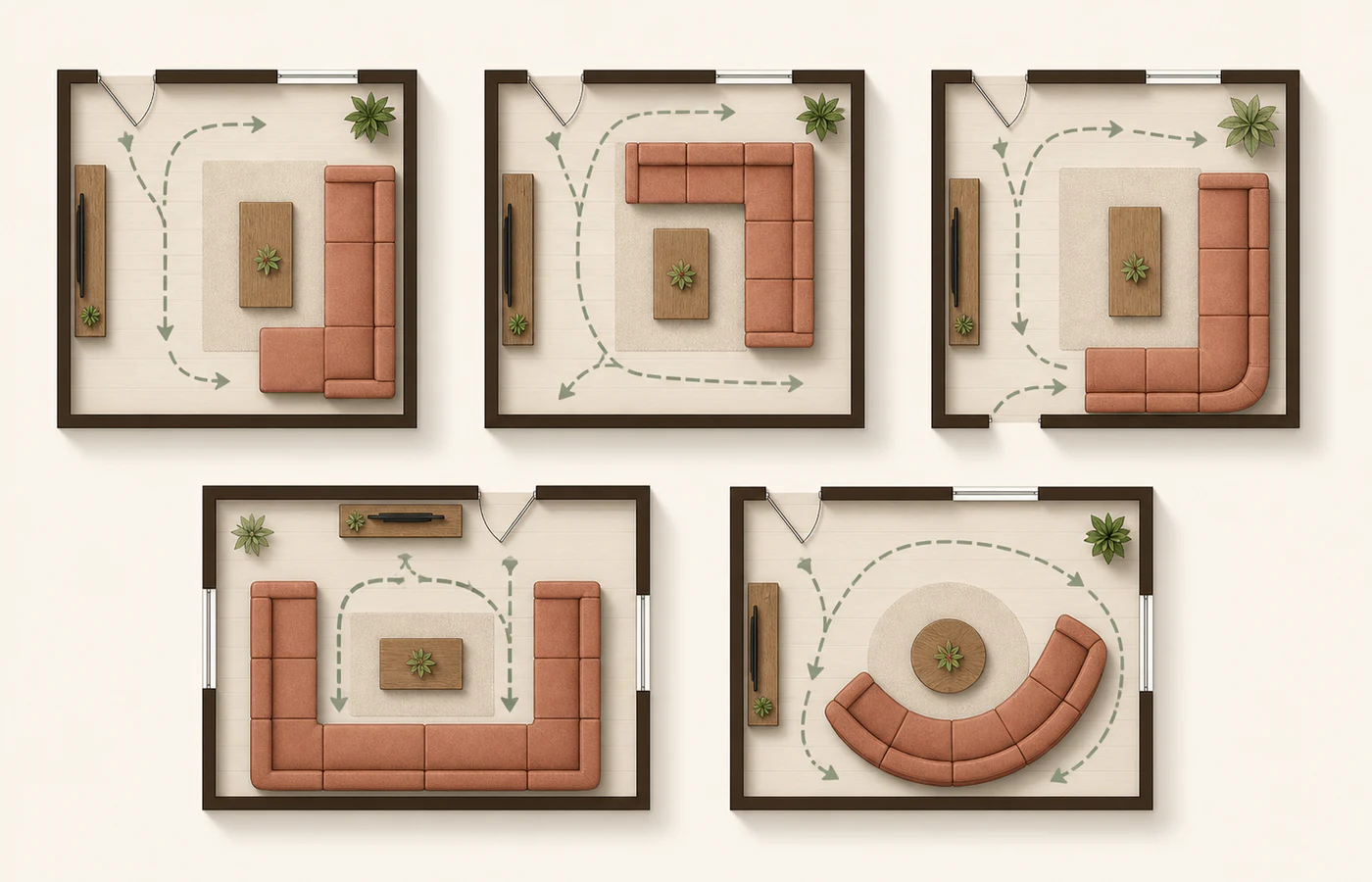
Sectional shape changes circulation, table access and future layout flexibility as much as seating capacity.
When a sectional is the wrong choice
A conventional sofa plus chairs may be better when:
- the room has several doors and no uninterrupted wall;
- seating needs to face more than one direction;
- occupants prefer different seat heights or firmness;
- the household moves frequently but the sectional is fixed;
- occasional large gatherings do not justify a permanent large footprint;
- a window, radiator or balcony route would be blocked;
- visual openness matters more than maximum seating.
Separate chairs can offer more ergonomic variety and are easier to reposition for conversation.
Measure the room in three layers
1. The sectional footprint
Mark total width, total depth, chaise projection and back height using painter’s tape. Use boxes or chairs to represent vertical volume; floor tape alone can make a large sofa feel deceptively harmless.
2. The operating room
Include:
- walking paths;
- coffee-table clearance;
- recliner or sleeper extension;
- cabinet and door swing;
- balcony access;
- floor vents and outlets;
- curtain movement;
- robot-vacuum access.
Aim for comfortable routes rather than squeezing to a theoretical minimum. The correct clearance depends on traffic frequency and accessibility needs.
3. The delivery route
Measure packaging as well as assembled furniture:
- building entrance;
- elevator door and cabin diagonal;
- stair width, landing and ceiling height;
- hallway turns;
- apartment doorway;
- removable doors, legs and railings;
- loading and parking restrictions.
Modularity helps only if each individual module fits.
Left-facing versus right-facing orientation
Never order based only on the phrase “left-facing.” Request a diagram showing the chaise and viewer position. Save the diagram with the order confirmation. Also confirm whether a corner module can be reconfigured or whether the upholstery and connectors make the arrangement permanent.
Connectors and module drift
Common systems include metal alligator clips, brackets, hooks, straps and interlocking feet. A useful connector should:
- prevent front-to-back and side-to-side drift;
- be reachable for assembly;
- avoid sharp exposed metal;
- tolerate repeated disconnection;
- keep seat heights aligned;
- not damage flooring.
Test the showroom model by sitting near the seam and getting up repeatedly. Modules should not separate or produce a hard ridge.
Corner comfort: count usable seats, not modules
The corner of an L or U sectional can be:
- a comfortable diagonal lounge seat;
- a deep square requiring extra pillows;
- a seat with no proper leg position;
- effectively unusable when adjacent people occupy both sides.
Sit in every position. Product photography often counts the corner as a full seat even when it works mainly as a transition.
Fixed versus modular comparison
| Question | Fixed sectional | Modular sectional |
|---|---|---|
| Initial price | Often lower | Often higher |
| Visual continuity | Fewer seams | More seams and repeated units |
| Reconfiguration | Limited | Strong when all sides are finished |
| Moving | Larger pieces | Smaller individual modules |
| Repair | Whole section may need service | Individual module may be replaceable |
| Expansion | Usually impossible | Possible only while system remains supported |
| Connector maintenance | Fewer connections | More clips, feet and alignment points |
Upholstery and cushion choices for sectionals
Large sectionals expose more fabric to sun, food and body contact. Color variation between replacement modules can become obvious. Ask whether covers are batch-dyed and whether later additions may differ.
Loose cushions allow rotation but can migrate between modules. Fixed seats look neat but concentrate wear. For deep sectionals, confirm cushion fill and maintenance; feather-rich backs may require frequent plumping across many units.
Sectional sofa red flags
- Orientation shown only in ambiguous text.
- No overall diagram with individual module dimensions.
- Product page counts modules rather than usable seats.
- Chaise or ottoman has no secure attachment.
- Connectors cannot be replaced.
- Expansion is advertised without a parts-availability commitment.
- Corner seat cannot be tested or is visibly harder than others.
- Delivery team will not confirm access responsibility.
- Covers are called removable but have no care instructions.
- Large custom order is non-returnable before swatches arrive.
Sectional buying checklist
- Exact footprint taped on floor and wall
- Walking and door paths tested
- Left/right orientation confirmed with diagram
- Each module dimension and weight recorded
- Delivery packaging measured
- All seating positions tested
- Connector system inspected
- Module drift and seam pressure checked
- Upholstery cleaning and replacement rules reviewed
- Cushion inserts and covers available separately
- Expansion policy and color-match risk understood
- Return, cancellation and assembly terms saved
Frequently asked questions
Is a sectional good for a small living room?
A compact reversible-chaise or apartment-scale modular sectional can use a corner efficiently. A bulky deep sectional can make the same room less functional than a small sofa and movable chair.
Is modular always better than fixed?
No. Modular is better when flexibility, moving and replacement matter. Fixed sectionals may cost less, show fewer seams and feel more visually integrated.
How do I know which chaise orientation to buy?
Use a retailer diagram and a floor plan. Do not rely on left/right terminology without confirming the viewing perspective.
Can sectional modules be mixed later?
Only within a supported system, and even then fabric dye lots, cushion firmness and dimensions may change. Treat future expansion as a possibility, not a guarantee.
How many people does a sectional really seat?
Count comfortable body positions, not cushions or modules. Test the corner and narrow armless units before accepting the advertised number.
Are sectionals harder to clean?
They can be. Debris collects between modules and under connectors, while deep configurations are harder to move. Removable modules may also make access easier if they disconnect safely.
Final verdict
Choose a sectional as a room-planning system, not as one oversized sofa. A modular L-shape ranks first because it balances useful seating with future adaptability; a reversible chaise is the safer compact option. Large U-shaped, reclining and pit configurations are excellent only when the room, access route and daily use justify their size and complexity.
Sources and verification notes
- POVISON Best Sectional Sofa Guidepovison.comChecked August 6, 2026
- Homzie Designs Sectional Buying Considerationshomziedesigns.comChecked August 6, 2026
- Castlery Sofa Buying Guidecastlery.comChecked August 6, 2026
- The Spruce Sofa Buying Guidethespruce.comChecked August 6, 2026
Policies, prices, product specifications and availability can change. Reopen official product and policy pages before publishing a time-sensitive update or making a purchase.