Sofa comparison
Sectional vs Modular Sofa: Which One Fits Your Space and Future Plans?
A practical sectional-versus-modular sofa guide covering terminology, room planning, connectors, comfort seams, delivery, moving, expansion, maintenance and long-term parts support.

On this page
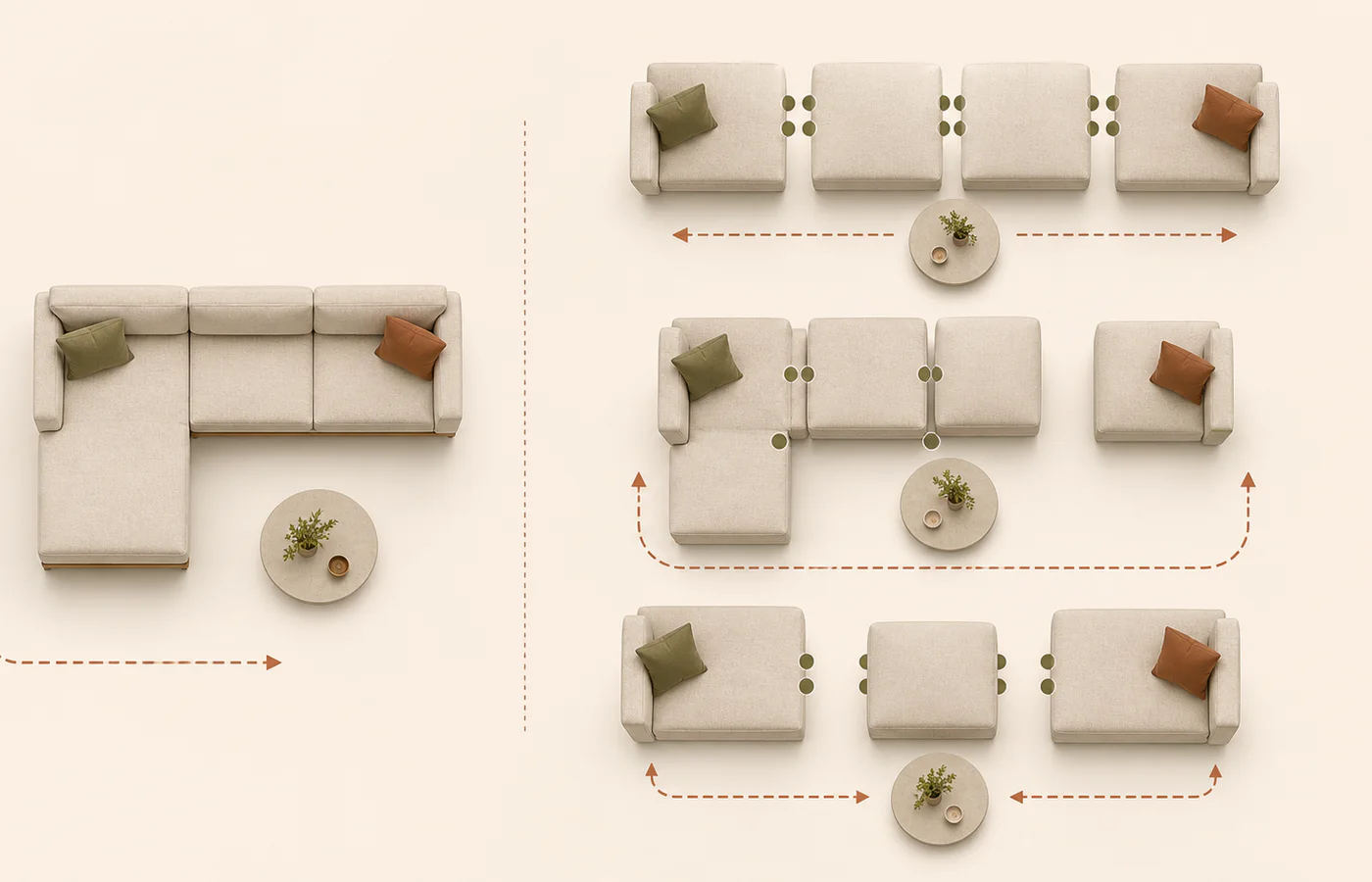
Quick verdictAt-a-glance comparisonWhy this question has a real search windowVerify whether the sofa is truly modularPlan usable seating, not module countConnectors decide everyday stabilitySeams change sitting and sleeping comfortDelivery and moving are different problemsExpansion depends on a living product ecosystemCleaning and repairBest choice by household and use caseA repeatable showroom and swatch testCommon buying mistakesPre-purchase checklistFrequently asked questionsFinal decision ruleSectional and modular are overlapping retail terms rather than strict engineering categories. A sectional is assembled from multiple sections into a larger shape; a modular system is designed around repeatable units that can be rearranged, expanded or separated. Some products are both, while others are marketed as modular even though only a few layouts work.
How to use this guide: Retail labels are inconsistent. Compare the exact dimensions, materials, mechanism, care instructions and current policies of the product you are considering. The recommendations below are decision rules rather than universal promises.
Quick verdict
Choose a conventional sectional when the room layout is stable, you want fewer seams and the orientation is unlikely to change. Choose a truly modular system when difficult delivery access, future moves, reconfiguration, washable covers or replaceable units justify more connectors, component inventory and cost.
At-a-glance comparison
| Decision factor | Conventional sectional | Modular sofa system |
|---|---|---|
| Layout | Usually a defined L, U or chaise arrangement | Units intended to rotate, separate or expand |
| Visual continuity | Fewer boundaries and a more continuous silhouette | More seams and repeated module lines |
| Comfort across joins | Often fewer connector zones | Must test sitting and lying over boundaries |
| Delivery | Two or three large sections are common | More smaller boxes; individual pieces may still be heavy |
| Future change | Orientation may be dedicated | Potentially reconfigurable if every side is compatible |
| Maintenance | Fewer covers and connectors | Local replacement can improve serviceability |
| Long-term risk | Dedicated chaise can become awkward after moving | Proprietary parts and discontinued fabrics can limit flexibility |
Why this question has a real search window
Modularity remains a strong 2026 furniture theme, and current search results include fresh explainers plus tested modular-sofa roundups. The user pain point is not vocabulary alone; it is whether flexibility will survive actual room planning, assembly, comfort seams and future parts availability.
Verify whether the sofa is truly modular
Map every unit: armless seat, corner, arm, side, back, chaise, ottoman, table and storage module. Identify which faces are finished and which depend on a neighboring piece. Meaningful modularity requires useful standalone or alternate roles, not merely the ability to disconnect two large sections. Ask whether standard and deep orientations use the same frame or different cushions and sides. A system can advertise many layouts while requiring extra parts for each change.
Plan usable seating, not module count
A six-module configuration does not necessarily seat six people. Arms, corners, chaises and broad gaps consume floor area. Mark the total footprint and then mark the real sitting positions, table reach and walking routes. Create a preferred layout and at least one credible future layout. When the fallback arrangement is awkward, the household may be paying a premium for theoretical flexibility.
Connectors decide everyday stability
Clamps, shoes, brackets, latches and anti-slip feet solve different movement problems. A good system resists sideways drift, vertical lift and racking without noise. Check whether connectors are included, accessible, tool-free and replaceable. Smooth floors expose weak systems quickly. Sit on an outside edge, push laterally and stand from a seam. A stable showroom center seat does not test the highest-leverage point.
Seams change sitting and sleeping comfort
Every module boundary can become a pressure line under a thigh or beneath a person lying across the sofa. Loose back cushions may migrate because each unit has its own geometry. Test directly over the connector, in the corner and across two seats. A conventional sectional may provide broader continuous cushions and fewer gaps, although dedicated corners can still be awkward. Match seam placement to naps, gaming, conversation and hosting.
Delivery and moving are different problems
Smaller modules can pass doors and elevators more easily, but a large system produces many boxes and repeated lifting. Check individual weight, carton count and assembly area. Fifty pounds is manageable once; it is a project when repeated twelve times. A conventional sectional has fewer pieces but may contain a long rigid chaise or corner. Confirm whether legs, arms or backs detach and whether the delivery service attempts stairs and tight turns.
Expansion depends on a living product ecosystem
The long-term promise depends on continued sales of compatible frames, covers, clamps and cushions. Ask whether dimensions have changed across generations and whether discontinued colors can be matched. Archive the system generation, upholstery code, fill and hardware list. Price one complete additional seat and one replacement cover now; accessories can make the real cost much higher than the headline seat price.
Cleaning and repair
Modularity can localize damage because one cover, cushion or frame may be replaced. That advantage exists only when parts are sold separately and the owner can remove and reinstall them correctly. A conventional sectional may have fewer zippers and less routine management, and professional upholstery can sometimes repair a single panel. Compare actual service routes rather than assuming modular automatically means sustainable.
Best choice by household and use case
| Situation | Better starting point | Why |
|---|---|---|
| Permanent media room | Conventional sectional | Stable orientation, fewer seams and cohesive appearance |
| Frequent mover | True modular system | Smaller units and alternate layouts reduce fit risk |
| Growing family | Modular system with proven parts support | Can add storage or seating |
| Minimalist formal room | Tailored sectional | Cleaner visual line |
| Tight apartment access | Parcel-scale modular system | Verify box weight and assembly space |
| Household that naps across the sofa | Sectional with broad continuous cushions | Fewer pressure lines |
| Pet or child household | System with replaceable washable covers | Local damage is easier to recover from |
A repeatable showroom and swatch test
Use the same sequence for every shortlisted model so a persuasive salesperson or attractive room photograph does not reset the criteria:
- Photograph the full specification and price, including the exact upholstery, fill and configuration.
- Measure the loaded seat depth, seat height, back contact point and usable width.
- Sit upright for at least ten minutes, lounge in the household’s normal posture and repeat the stand-up motion.
- Test the least comfortable-looking position: a connector seam, center seat, corner, front edge or mechanism transition.
- Recreate the full footprint at home with tape, including open or converted dimensions where relevant.
- Price delivery, assembly, returns, replacement covers or cushions and the likely repair route.
- Save screenshots or PDFs of date-sensitive policies before placing the order.
Common buying mistakes
- Treating “modular” as proof every unit can rotate or stand alone.
- Counting modules instead of usable seats and circulation.
- Ignoring seam placement for lying down.
- Assuming smaller boxes mean effortless assembly.
- Buying without checking replacement covers and connectors.
- Failing to save generation and fabric codes.
Pre-purchase checklist
- Every module and finished side mapped.
- Preferred and fallback layouts drawn to scale.
- Connector type and spare parts confirmed.
- Seams tested in sitting and lying positions.
- Carton dimensions and weights checked.
- Full configuration price includes sides, covers and delivery.
- Future compatibility documented.
- Return logistics modeled for every box.
Frequently asked questions
Is every modular sofa a sectional?
A modular sofa can form a sectional, but it may also separate into chairs or linear layouts. Retail terminology varies.
Are modular sofas less stable?
Not necessarily. Good connectors feel solid; weak clamps or slippery feet create movement.
Which is easier to move?
Modular units are smaller but numerous. Conventional sectionals have fewer pieces but can include long rigid components.
Can I add modules years later?
Only if the brand maintains compatible frames, covers, cushions and hardware.
Are modular sofas better for small rooms?
Sometimes, but many are deep and wide. Total footprint and usable seating still decide fit.
Final decision rule
Choose a conventional sectional when the room layout is stable, you want fewer seams and the orientation is unlikely to change. Choose a truly modular system when difficult delivery access, future moves, reconfiguration, washable covers or replaceable units justify more connectors, component inventory and cost.
Sources and verification notes
- Nova Furnishing — Sectional vs Modular Sofanovafurnishing.comChecked August 6, 2026
- Commune — Modular vs Sectional Sofathecommunelife.comChecked August 6, 2026
- DreamSofa — Sectional vs Modular Sofadreamsofa.comChecked August 6, 2026
- Lovesac Sactionalslovesac.comChecked August 6, 2026
- Anabei Modular Washable Sofaanabei.comChecked August 6, 2026
- Real Simple — Best Modular Sofasrealsimple.comChecked August 6, 2026
- The Spruce — Best Modular Sofas Testedthespruce.comChecked August 6, 2026
- Crate & Barrel — Measuring Furniture for Deliverycrateandbarrel.comChecked August 6, 2026
Policies, prices, product specifications and availability can change. Reopen official product and policy pages before publishing a time-sensitive update or making a purchase.