Category Buying Guide
Best Recliner Sofa Types: Mechanisms, Features and Safety Ranked
Compare eight recliner sofa types by comfort adjustment, reliability, clearance, power, serviceability, accessibility and family safety.

On this page
Quick answerKey takeawaysRecliner sofa rankings at a glanceHow we ranked recliner sofas1. Power wall-hugger recliner sofa — best overall2. Manual wall-hugger sofa — best simple compact option3. Dual-power headrest and footrest sofa — best posture customization4. Standard power reclining sofa — best assisted everyday use5. Manual lever reclining sofa — best budget mechanism6. Power reclining loveseat — best for two-person compact use7. Reclining sectional — best large media-room configuration8. Theater-style console recliner — best only for dedicated cinema useManual versus power reclinersMeasure the full operating envelopePosture test: what to feel in every positionFrame, suspension and mechanism inspectionPower and cable planningChild and pet safetyUpholstery choices for reclinersRecliner sofa red flagsRecliner sofa buying checklistFrequently asked questionsFinal verdictA reclining sofa is upholstered furniture plus moving equipment. The mechanism changes weight, wall clearance, cable routing, pinch zones, failure modes and repair cost. A feature-rich model can be excellent when parts and service are available; the same features can become liabilities when the motor, switch or proprietary control fails.
Editorial status: This ranking compares common recliner configurations and mechanisms. It does not certify product safety or medical suitability. Review current recalls, manufacturer instructions, local electrical requirements and household risks before purchase.
Quick answer
A power wall-hugger recliner sofa with independent back and footrest adjustment is the best all-round choice when the room has an outlet and the manufacturer supports replacement parts. A simple manual wall-hugger ranks second for buyers prioritizing lower cost and fewer electrical components. Multi-motor models offer the best fine adjustment but are heavier and more complex. Reclining sectionals and console-heavy theater designs suit dedicated rooms rather than general living spaces.
Key takeaways
- Measure the fully open operating envelope, including forward travel and footrest clearance.
- Power improves fine adjustment and accessibility; manual mechanisms reduce electrical complexity.
- Wall-hugger designs save rear space but still need clear floor area in front.
- Compare mechanism, motor, transformer and frame warranties separately.
- Child and pet safety, cable routing and replacement parts matter more than cupholders or USB ports.
Recliner sofa rankings at a glance
| Rank | Recliner type | Best for | Main strength | Main compromise |
|---|---|---|---|---|
| 1 | Power wall-hugger sofa | Most homes with limited rear clearance | Smooth adjustment and compact wall spacing | Motor, wiring and outlet dependence |
| 2 | Manual wall-hugger sofa | Reliability and value | Fewer electrical parts and flexible placement | Physical effort and fewer positions |
| 3 | Dual-power headrest and footrest sofa | Mixed postures and TV use | Fine upper- and lower-body adjustment | More motors and higher repair complexity |
| 4 | Standard power reclining sofa | Everyday assisted reclining | Easy operation and intermediate positions | Needs more wall/floor clearance |
| 5 | Manual lever reclining sofa | Budget family rooms | Simple mechanism and lower price | Jerky closure and leg effort |
| 6 | Power reclining loveseat | Compact households | Two customized seats in narrow width | Limited center seat and high cost per seat |
| 7 | Reclining sectional | Large media rooms | Multiple loungers and group seating | Very heavy, wired and hard to move |
| 8 | Theater-style console recliner sofa | Dedicated cinema rooms | Storage, charging and cupholders | Bulky, visually specialized and harder to repair |
How we ranked recliner sofas
The ranking weighs:
- posture quality through the full motion range;
- rear and front operating clearance;
- ease of use for different strength and mobility levels;
- mechanism and electrical serviceability;
- cable and pinch-zone management;
- frame and seat durability under moving loads;
- furniture weight and delivery complexity;
- usefulness outside of full recline.
USB ports, cupholders and lights were treated as secondary features. They do not compensate for poor support or an unsupported mechanism.
1. Power wall-hugger recliner sofa — best overall
A wall-hugger or wall-away design moves the seat forward as the back reclines, reducing the gap needed behind the sofa. Power control allows the user to stop at intermediate angles rather than choosing only fixed positions.
The strongest models document fully reclined dimensions, motor access, transformer specifications and replacement switches. Check whether the sofa still needs space in front and whether the moving seat collides with a rug or coffee table.
Why it ranks first: excellent balance of adjustability and room efficiency.
Who should avoid it: homes without safe outlet access or buyers unwilling to maintain electrical components.
2. Manual wall-hugger sofa — best simple compact option
This design combines a forward-moving mechanism with manual operation. It can fit closer to a wall without adding motors, transformers or standby power.
The lever or push-back action should be manageable for the weakest regular user. Closing a footrest can require more force than opening it. Test repeated cycles, not one showroom demonstration.
Why it ranks second: compact placement with fewer potential electrical failures.
Who should avoid it: users with limited leg or hand strength.
3. Dual-power headrest and footrest sofa — best posture customization
Dual-power models allow the back/head area and footrest to move independently. This matters because a user may want elevated legs while keeping the torso upright, or recline the torso while maintaining a forward screen-viewing angle.
More control does not guarantee good ergonomics. Confirm that the lumbar region remains supported and the headrest does not push the neck forward. Ask whether each motor and switch can be replaced separately.
Why it ranks third: strongest adjustment range for mixed activities and body proportions.
Who should avoid it: buyers prioritizing mechanical simplicity and lower lifetime repair cost.
4. Standard power reclining sofa — best assisted everyday use
A conventional power recliner uses a motor to extend the footrest and tilt the back, often with one control. It is useful for people who find manual mechanisms difficult and for anyone who wants smoother movement.
It may require more rear clearance than a wall-hugger. Check operation during power loss: some models have battery backup options, while others remain in position until power returns.
Why it ranks fourth: accessible and smooth, but less space-efficient than the top-ranked design.
Who should avoid it: rooms without reliable power or clear cable routes.
5. Manual lever reclining sofa — best budget mechanism
Manual lever recliners are widely available and use relatively simple mechanical linkages. They often cost less and can sit away from outlets.
Common frustrations include a stiff handle, sudden release, limited intermediate positions and a footrest that needs forceful kicking to close. Inspect the handle material and cable connection; these are frequent service points.
Why it ranks fifth: straightforward value with clear trade-offs.
Who should avoid it: users with hand, knee or hip limitations.
6. Power reclining loveseat — best for two-person compact use
A reclining loveseat provides two independent loungers without the width of a three-seat sofa. It can work in apartments and bedrooms when both occupants want personalized positions.
The center may be a narrow fixed gap or console, so the piece is not equivalent to a conventional loveseat for a child or guest. Measure arm width and usable seat width carefully.
Why it ranks sixth: efficient for two dedicated users, less flexible for general seating.
Who should avoid it: households that frequently need three across or nap lengthwise.
7. Reclining sectional — best large media-room configuration
A reclining sectional combines group seating with motion seats. It can be ideal for sports, films and gaming when the room is designed around one screen.
Weight, cable routing and service access become serious concerns. One failed powered module may be trapped between heavy fixed pieces. Check whether each module disconnects, whether cables pass safely through connectors and how technicians reach the mechanism.
Why it ranks seventh: powerful specialized comfort but high ownership complexity.
Who should avoid it: frequent movers, flexible living rooms or households needing open circulation.
8. Theater-style console recliner — best only for dedicated cinema use
These sofas add center consoles, cupholders, storage, lighting and multiple charging ports. The features can be useful in a home theater but consume seat width and create more electrical and cleaning points.
Integrated electronics may date faster than the upholstery. Ask whether USB modules and controls are standard replaceable parts or proprietary assemblies.
Why it ranks eighth: excellent in one context, poor as a versatile main sofa.
Who should avoid it: design-led living rooms, small spaces and buyers wanting a long, simple sleeping surface.
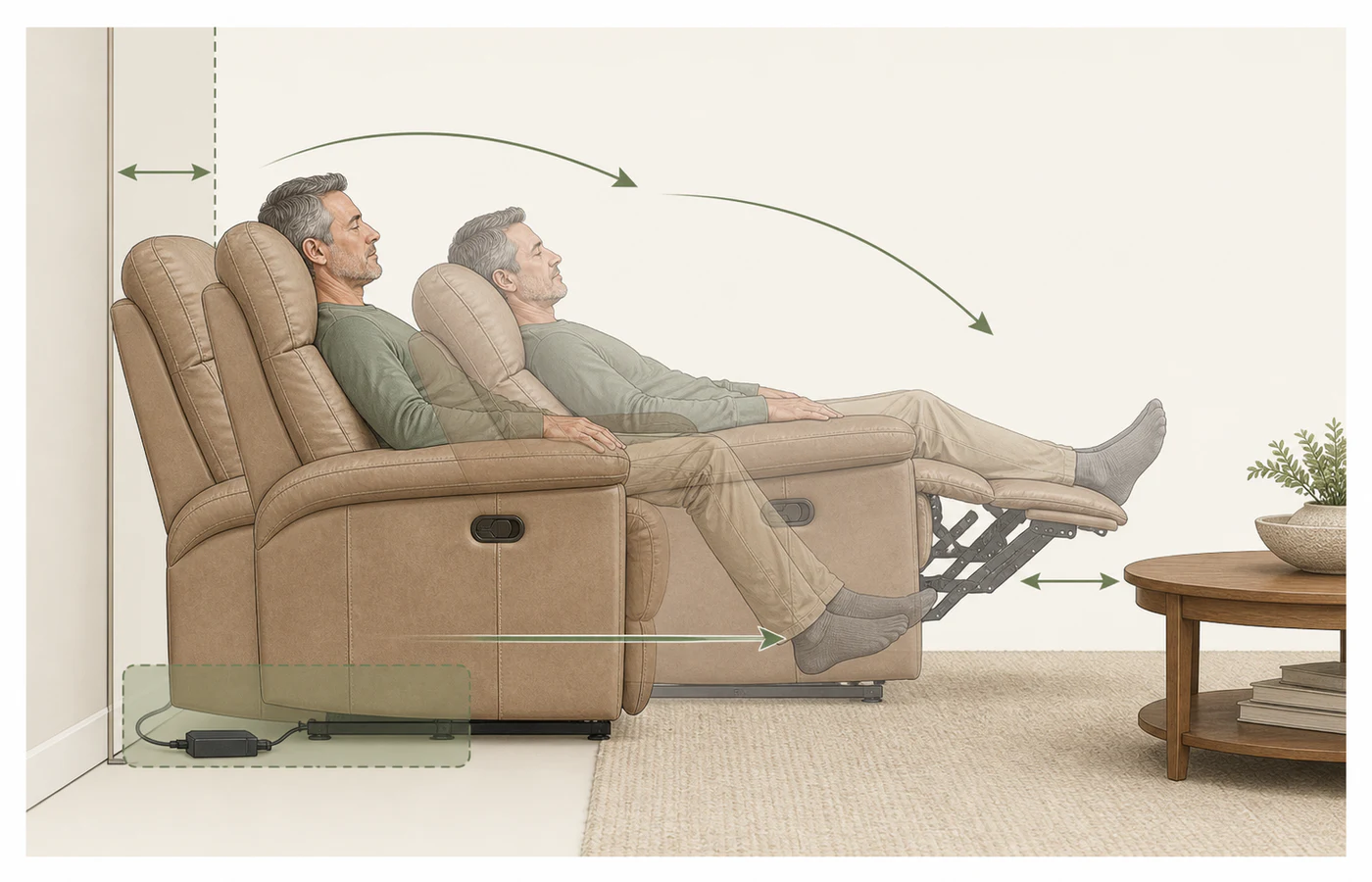
Measure the complete operating envelope, including wall gap, forward travel, footrest reach and cable clearance.
Manual versus power recliners
| Question | Manual | Power |
|---|---|---|
| Purchase cost | Usually lower | Usually higher |
| Number of positions | Often limited | Usually continuous or multi-position |
| Physical effort | Lever, body weight or leg force | Button control |
| Outlet needed | No | Usually yes |
| Moving weight | Lower | Higher |
| Failure points | Cable, lever, linkage | Motor, switch, transformer, wiring plus linkage |
| Power outage | Operates normally | May remain in position without backup |
| Fine posture control | Limited | Better, especially with multiple motors |
Neither type is automatically more durable. A well-built power mechanism with supported parts can outlast a poorly built manual one.
Measure the full operating envelope
Record both closed and fully open dimensions:
- total closed depth;
- wall clearance;
- forward seat travel;
- footrest extension;
- headrest height;
- distance to coffee table or media unit;
- cable reach and outlet position;
- room for walking around an occupied recliner.
Use tape and a chair to simulate the raised footrest. A specification that lists only closed dimensions is incomplete for room planning.
Posture test: what to feel in every position
Upright
Feet should reach the floor if the sofa will be used for conversation. The seat should not tilt backward so strongly that standing becomes difficult.
TV position
The head should face forward without the chin being forced down. Lumbar support should remain present when the footrest rises.
Full recline
Check whether heels are supported or hang beyond the footrest. Notice any gap behind the knees, neck or lower back.
Return to upright
The motion should be smooth and controlled. Manual footrests should not slam; power mechanisms should not grind or hesitate.
Frame, suspension and mechanism inspection
Moving seats place repeated loads on the frame. Ask for:
- frame material around mechanism mounts;
- steel gauge or mechanism manufacturer where disclosed;
- maximum user weight per reclining seat;
- whether seat suspension differs between fixed and moving positions;
- access panel or route for service;
- mechanism, motor and frame warranty periods separately;
- labor and call-out coverage after the first year.
Sit on the fixed center seat and moving end seats. Comfort should not change abruptly unless the design explains why.
Power and cable planning
- Use the manufacturer-approved transformer.
- Avoid running loose cords across walkways.
- Do not trap cables under moving modules.
- Keep connectors accessible for inspection.
- Ask whether a floor outlet, wall outlet or rechargeable battery is recommended.
- Review surge-protection guidance.
- Confirm local plug type and voltage for imported furniture.
Built-in USB ports may supply limited power and can become obsolete. Treat them as replaceable conveniences, not a core reason to buy the sofa.
Child and pet safety
Recliners contain moving gaps and scissor-like mechanisms. Keep children and animals away while operating the sofa, inspect beneath and behind it before closing, and follow all manufacturer warnings. Toys and blankets can enter mechanisms. A skirt or covered base may reduce access but does not eliminate risk.
Check current recalls before purchasing used or discontinued motion furniture. Stop using a mechanism that behaves unpredictably, exposes wiring or produces unusual heat or odor.
Upholstery choices for recliners
Moving seams flex repeatedly. Inspect fabric and leather around footrest corners, side panels and hinged backs. Tight upholstery may crease as intended; excessive rubbing can create early wear.
- Protected leather is easy to wipe but may show scratches near controls.
- Tight performance fabric offers broad family use.
- Loose loops can catch near moving joints.
- Removable covers are uncommon because upholstery attaches around mechanisms.
Ask how upholstery repair is performed without replacing the whole moving seat.
Recliner sofa red flags
- Fully open dimensions are missing.
- Controls are unreachable when reclined.
- Footrest stops short of supporting the lower legs.
- Headrest forces the chin down.
- Mechanism squeaks, twists or moves asymmetrically in the showroom.
- No separate mechanism or motor warranty.
- Proprietary switch or transformer has no part number.
- Cables exit into a walkway with no routing plan.
- Child/pet warnings are absent.
- Delivery team cannot explain how the sofa separates into modules or backs.
Recliner sofa buying checklist
- Manual versus power decision based on actual users
- Closed and open footprints taped out
- Wall and front clearance confirmed
- All positions tested for at least one full viewing session
- Foot, lumbar and head support checked
- Standing and closing effort tested
- Mechanism, motor and frame warranties compared
- Replacement parts and service access confirmed
- Cable route and outlet planned
- Child and pet hazards reviewed
- Upholstery flex points inspected
- Delivery weight, removable backs and stairs measured
Frequently asked questions
Is a power recliner better than a manual recliner?
It is better for fine adjustment and low-effort operation. Manual is better for lower cost, fewer electrical parts and placement away from outlets. The right choice depends on users and service support.
What is a wall-hugger recliner?
It moves the seat forward while reclining so the back needs less space from the wall. It still requires front clearance for the footrest and moving seat.
Can a recliner sofa be placed in the middle of a room?
Yes, especially a manual model, but the rear mechanism and cables must look finished and remain protected. Power models need a safe outlet or approved battery solution.
How long should a recliner mechanism last?
There is no reliable universal number. Usage frequency, user weight, mechanism quality, alignment, maintenance and parts support all matter. Warranty and serviceability are more useful than a generic lifespan promise.
Are recliner sofas safe for children and pets?
They require active precautions because moving gaps can trap objects, tails or limbs. Follow manufacturer guidance and supervise operation.
Can a power recliner close during an outage?
Not always. Ask whether the model supports battery backup or a manual release and understand the procedure before purchase.
Final verdict
A recliner sofa should be bought like an appliance wrapped in upholstery. The power wall-hugger ranks first because it combines room efficiency with smooth adjustment, but only when parts, wiring and service are credible. Simpler manual designs remain the better choice for buyers who value mechanical independence. Prioritize posture, clearance and repair access before cupholders or charging ports.
Sources and verification notes
- POVISON Reclining Sofa Buying Guidepovison.comChecked August 6, 2026
- Dreamo Recliner Sofa Buying Guidedreamo.com.auChecked August 6, 2026
- Xclusive Home Recliner Sofa Guidexclusivehome.sgChecked August 6, 2026
- The Spruce Sofa Buying Guidethespruce.comChecked August 6, 2026
- CPSC Recliner Child-Entrapment Warningcpsc.govChecked August 6, 2026
Policies, prices, product specifications and availability can change. Reopen official product and policy pages before publishing a time-sensitive update or making a purchase.