Sofa comparison
Reclining Sofa vs Regular Sofa: Is the Extra Cost and Space Worth It?
Compare reclining and fixed sofas by comfort, posture, open clearance, weight, power, safety, serviceability, aesthetics, price and long-term ownership.

On this page
Quick verdictAt-a-glance comparisonWhy this question has a real search windowMeasure the operating envelopeTest the entire motion rangePower, batteries and cablesChildren and petsWeight, delivery and floorsRepairability and warrantyAesthetics and flexibilityBest choice by household and use caseCalculate the real ownership premiumA repeatable showroom and swatch testCommon buying mistakesPre-purchase checklistFrequently asked questionsFinal decision ruleA reclining sofa is upholstered furniture plus moving equipment. Footrests, hinges, cables, motors, switches and articulated backs can deliver adjustable comfort, but they add an operating envelope, weight, pinch zones and service requirements that a fixed sofa does not have.
How to use this guide: Retail labels are inconsistent. Compare the exact dimensions, materials, mechanism, care instructions and current policies of the product you are considering. The recommendations below are decision rules rather than universal promises.
Quick verdict
A recliner is worth the trade-off when one or more people will use adjustable posture almost every day and the room supports its open footprint, wiring and service access. A regular sofa is the better default when flexible placement, visual simplicity, lower weight and easier repair matter more than built-in leg support.
At-a-glance comparison
| Decision factor | Reclining sofa | Regular fixed sofa |
|---|---|---|
| Posture | Independent foot, back, head or lumbar adjustment | Fixed geometry; pillows and ottoman add flexibility |
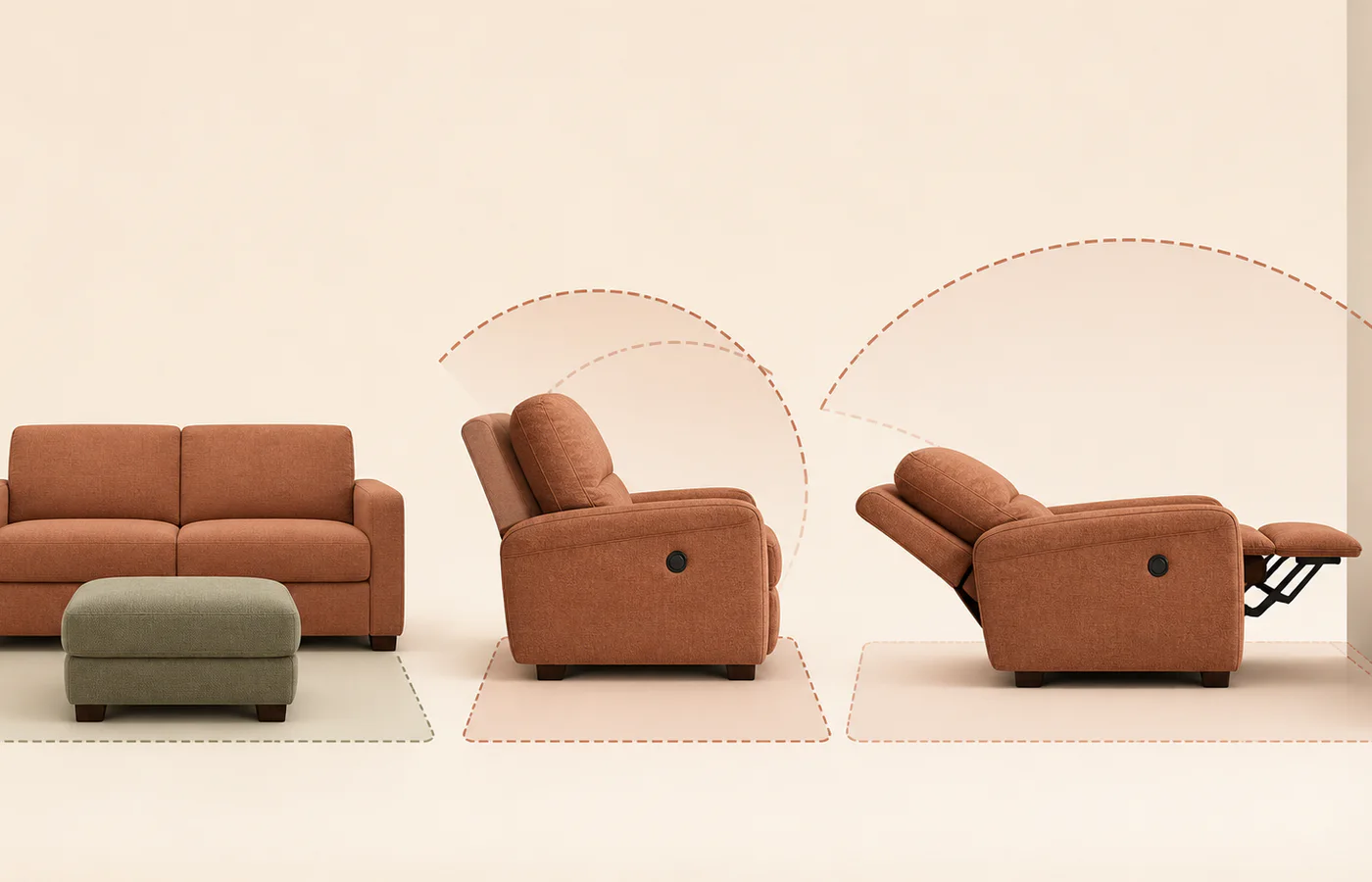
| Footprint | Measure fully open and during movement | Usually only closed footprint matters |
| Weight | Mechanisms and motors add mass | Usually lighter at a comparable size |
| Power | Outlet, cord, transformer or battery may be required | No electrical dependency |
| Safety | Moving gaps and extended footrests | Fewer mechanical hazards |
| Service | Motors, switches, cables and mechanisms | Upholstery, cushions, suspension and frame |
| Style | Often thicker, though tailored models exist | Broader range of light and floating silhouettes |
Why this question has a real search window
Fresh 2026 “is a recliner worth it?” pages show clear commercial intent. Users are not merely defining the product; they are weighing comfort against floor space, price, mechanisms and regret. AboutSofa can improve on retailer answers by treating motion seating as equipment with safety and service needs.
Measure the operating envelope
Tape the fully open depth and trace the moving back and footrest. Leave room to enter, exit, walk past and reach a side table. “Wall-hugger” does not mean zero clearance. Plan where the coffee table goes during use. A sofa that technically opens but requires nightly furniture moving can become a daily irritation.
Test the entire motion range
Pause at intermediate angles and check footrest length, lumbar contact and head position. Comfort is not just the fully upright and fully reclined endpoint. Manual mechanisms avoid motors but can require force to close. Power offers finer adjustment but depends on controls and electricity. Test how a user exits during an outage.
Power, batteries and cables
Locate grounded outlets and ventilate transformers. Route cords where moving parts cannot pinch them and where people will not trip. Battery packs add charging and replacement tasks. Register powered furniture and check current safety notices. A recall example does not condemn the category; it shows why model identification and service access matter.
Children and pets
Moving mechanisms create gaps beneath footrests and between frames. Keep children and pets clear during operation, never permit play on an extended footrest and inspect underneath before closing. Place the sofa so an adult can see the moving parts. Crowded toys and hidden gaps increase management risk.
Weight, delivery and floors
Mechanism boxes can be much heavier than ordinary modules. Confirm each carton and component weight, stair access and whether backs detach. White-glove delivery cannot solve an impossible turn. Use suitable glides and check concentrated load on delicate flooring. Future moves may require technician disassembly or several adults.
Repairability and warranty
Ask whether the motor, switch, transformer, control cable and mechanism are separately replaceable. Identify local service and who pays labor and transport. A long frame warranty can coexist with short electronics coverage. A fixed sofa has fewer failure points but still needs serviceable cushions and suspension. Compare likely powered-part cost with a separate ottoman or adjustable chair.
Aesthetics and flexibility
Modern recliners can hide movement within tailored forms, but the mechanism often dictates a thicker base, deeper back and less clearance beneath the sofa. A regular sofa is easier to float and combine with varied chairs. Buy the recliner because the function will be used, not because controls look impressive. Ports and electronics age faster than a sound furniture frame.
Best choice by household and use case
| Situation | Better starting point | Why |
|---|---|---|
| Daily primary TV seat | Reclining sofa | Frequent adjustment can justify the premium |
| Small multipurpose room | Regular sofa plus ottoman | Floor space remains flexible |
| Young children or pets | Regular sofa or strictly supervised recliner | Moving gaps increase management |
| Independent leg support needed | Power recliner with separate controls | Fine adjustment is the key benefit |
| Frequent mover | Regular sofa | Lower weight and simpler placement |
| Power outage resilience | Manual recliner or fixed sofa | Avoid electrical dependence |
| Design-led formal room | Tailored fixed sofa | Wider visual choice |
Calculate the real ownership premium
The purchase-price gap is only the first part of the recliner premium. Build a five-year comparison that includes delivery surcharges, outlet or floor-box work, battery packs, transformer replacement, service visits and the possibility that one powered seat fails before the upholstery or frame. Compare that with a fixed sofa plus a high-quality ottoman or adjustable footstool.
| Cost or constraint | Reclining sofa | Fixed sofa plus ottoman |
|---|---|---|
| Initial furniture price | Usually higher for comparable upholstery | Often lower, depending on ottoman |
| Electrical work | Possible outlet, cable or battery cost | None |
| Moving and delivery | Heavier mechanism sections | More flexible separate pieces |
| Repair points | Switches, cables, motors and mechanism | Frame, suspension and upholstery |
| Leg support | Integrated and individually adjustable | Movable but occupies separate floor space |
| Future layout | Constrained by operating envelope | Ottoman can move or be removed |
Ask the retailer for the price and availability of a motor, switch, transformer and hand control before purchase. A written parts answer is more useful than a vague claim that the mechanism is “built to last.” For manual recliners, test release force and whether every user can close the footrest safely without twisting.
A repeatable showroom and swatch test
Use the same sequence for every shortlisted model so a persuasive salesperson or attractive room photograph does not reset the criteria:
- Photograph the full specification and price, including the exact upholstery, fill and configuration.
- Measure the loaded seat depth, seat height, back contact point and usable width.
- Sit upright for at least ten minutes, lounge in the household’s normal posture and repeat the stand-up motion.
- Test the least comfortable-looking position: a connector seam, center seat, corner, front edge or mechanism transition.
- Recreate the full footprint at home with tape, including open or converted dimensions where relevant.
- Price delivery, assembly, returns, replacement covers or cushions and the likely repair route.
- Save screenshots or PDFs of date-sensitive policies before placing the order.
Common buying mistakes
- Measuring only closed dimensions.
- Testing only fully reclined position.
- Ignoring cord routing and transformer ventilation.
- Assuming frame warranty includes electronics.
- Allowing children or pets near moving footrests.
- Buying features without checking serviceability.
Pre-purchase checklist
- Fully open footprint taped.
- Intermediate positions tested.
- Footrest length and head angle checked.
- Outlet, cord and battery plan completed.
- Child and pet rules accepted.
- Component and carton weights checked.
- Mechanism and electronics warranties separated.
- Local service route confirmed.
Frequently asked questions
Are wall-hugger recliners suitable for small rooms?
They reduce rear clearance but the footrest still extends forward and the sofa remains heavy.
Is power better than manual?
Power gives finer control; manual avoids motors and outlets. Strength, desired positions and service tolerance decide.
Can a recliner help back pain?
Some people find adjustable posture comfortable, but furniture is not treatment. Seek individual medical guidance for pain.
How long do motors last?
There is no universal lifespan. Usage, load, component quality and service matter.
Is a sofa plus ottoman more flexible?
Usually yes, though it does not coordinate back angle and still uses floor space.
Final decision rule
A recliner is worth the trade-off when one or more people will use adjustable posture almost every day and the room supports its open footprint, wiring and service access. A regular sofa is the better default when flexible placement, visual simplicity, lower weight and easier repair matter more than built-in leg support.
Sources and verification notes
- Maxi Home — Are Recliner Sofas Worth It?maxihome.com.sgChecked August 6, 2026
- Megafurniture — Is a Recliner Worth It?megafurniture.sgChecked August 6, 2026
- CPSC — Recliner Child-Entrapment Warningcpsc.govChecked August 6, 2026
- CPSC — 2026 Power Furniture Recall Examplecpsc.govChecked August 6, 2026
- Lovesac — Reclining Sactionalslovesac.comChecked August 6, 2026
- Pottery Barn — How to Measure for Furniturepotterybarn.comChecked August 6, 2026
- Dreamo — Recliner Sofa Buying Guidedreamo.com.auChecked August 6, 2026
- Povison — Reclining Sofa Guidepovison.comChecked August 6, 2026
Policies, prices, product specifications and availability can change. Reopen official product and policy pages before publishing a time-sensitive update or making a purchase.