Sofa comparison
Leather vs Fabric Sofa: Which Is Better for Comfort, Pets, Kids and Long-Term Value?
A detailed leather-versus-fabric sofa comparison covering comfort, climate, pets, children, cleaning, durability, allergies, cost, repairability and long-term appearance.

On this page
Quick verdictAt-a-glance comparisonWhy this question has a real search windowIdentify the exact surface before comparing pricesComfort and climate are more nuanced than hot versus coldPets: choose for shedding, scratching and digging separatelyChildren, food and biological spillsDurability, appearance and repairAllergies and routine hygieneTotal cost over five to ten yearsBest choice by household and use caseA repeatable showroom and swatch testCommon buying mistakesPre-purchase checklistFrequently asked questionsFinal decision ruleLeather and fabric are not two uniform materials. Protected pigmented leather behaves differently from full-aniline hide, while a dense performance weave behaves differently from loose linen, chenille or bouclé. The useful comparison starts with the exact surface, finish, backing and care route, then adds the frame, suspension and cushions underneath.
How to use this guide: Retail labels are inconsistent. Compare the exact dimensions, materials, mechanism, care instructions and current policies of the product you are considering. The recommendations below are decision rules rather than universal promises.
Quick verdict
For the broadest range of households, a well-documented performance fabric is the safer all-rounder because it offers more textures, a less temperature-sensitive initial feel and potentially replaceable covers. Protected top-grain or semi-aniline leather is compelling for buyers who prioritize wipe-clean maintenance, lower hair retention and visible patina. Neither category wins for every pet, child, climate or budget.
At-a-glance comparison
| Decision factor | Leather sofa | Fabric sofa |
|---|---|---|
| Immediate feel | Smooth and temperature-responsive | Usually softer and less temperature-responsive |
| Spills | Protected finishes wipe quickly; aniline absorbs faster | Depends on cleaning code, backing and removable-cover rules |
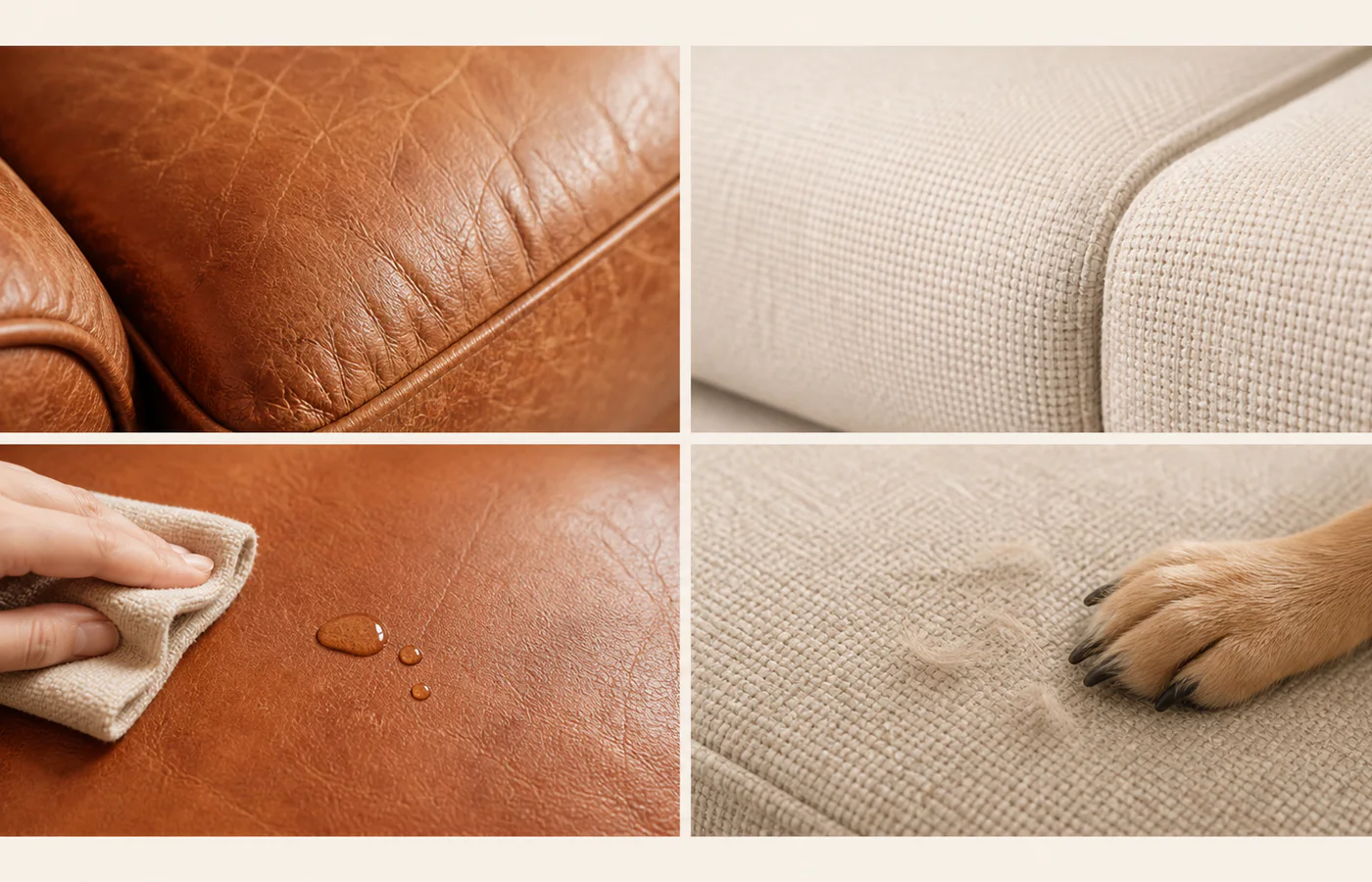
| Pets | Hair is easy to remove; claws can leave permanent marks | Dense weaves resist snags; loops trap hair and catch claws |
| Aging | Creasing, patina, scratches and color shift | Pilling, fading, compression and staining vary widely |
| Repair | Professional recoloring or panel repair may be possible | Spot repair, replacement covers or reupholstery may be possible |
| Choice | Fewer textures and colors within each grade | Very broad color, pattern, texture and price range |
| Upfront cost | Quality hide is usually more expensive | Ranges from inexpensive synthetics to premium natural textiles |
Why this question has a real search window
Current 2026 results contain numerous fresh regional comparisons, retailer guides and editorial explainers, which signals a durable purchase question rather than a fading trend. The opportunity is not another generic list of pros and cons; it is a more exact decision framework that distinguishes leather grades, fabric constructions, climate, animal behavior and repair options.
Identify the exact surface before comparing prices
Ask whether the leather is full-aniline, semi-aniline, pigmented or protected, split, bonded, leather-match or synthetic. Ask which panels use which material. A sofa described only as “genuine leather” leaves grain, finish, thickness and panel coverage unanswered. The FTC Leather Guides are useful because they reinforce the need for accurate material representation rather than vague prestige language. For fabric, record fiber percentages, weave type, backing, finish, cleaning code, abrasion method, pilling result and lightfastness where available. “Performance fabric” is a marketing family, not a regulated grade. A solution-dyed tight weave and a lightly treated decorative polyester should not be treated as equivalents.
Comfort and climate are more nuanced than hot versus cold
Leather changes temperature quickly. It may feel cool in an air-conditioned room and warm or tacky against bare skin in a naturally ventilated space. Fabric adds friction and usually feels warmer at first, but plush piles can retain heat. Direct sun, ventilation, clothing and air-conditioning habits matter more than a universal climate claim. The upholstery is only the contact layer. Seat depth, back angle, foam firmness and cushion wrap determine most posture and pressure distribution. A soft textile cannot rescue an excessively deep seat for an upright shorter sitter, and an expensive hide cannot compensate for weak suspension.
Pets: choose for shedding, scratching and digging separately
For a shedding dog, smooth leather and short dense textiles are easier to vacuum than loose high-texture cloth. For a cat that scratches, neither category is pet-proof: leather records claw marks, while looped or loose weaves can pull. Dense microfiber or a stable flat weave is often the least risky starting point, but a swatch test is more useful than a broad category name. Color matters almost as much as material. Medium mottled tones close to the animal’s hair hide everyday evidence better than black leather or stark white cloth. Separate cushions, accessible crevices and purchasable covers reduce the cost of inevitable damage.
Children, food and biological spills
Protected leather buys response time because liquid often remains on the surface, but stitching and cushion gaps still allow penetration. Aniline leather may absorb a spill quickly. Fabric with a documented moisture barrier or a true washable slipcover can recover well when the brand permits laundering and the inner layers can dry safely. Do not rely on a wine-spill demonstration. Check the approved cleaner, response window, warranty exclusions and treatment of oil, sunscreen, marker, denim dye and pet accidents. The family-friendly winner is the sofa with a believable recovery process.
Durability, appearance and repair
Good leather can last a long time, but visible change is part of ownership. Full-aniline hide shows scars, oils, creasing and sunlight more readily; protected leather is more uniform and stain-resistant but can feel less natural. Bonded surfaces may peel when their composite layer fails. Fabric wear is more varied. Abrasion tests are screening tools, not lifespan promises, and do not predict pilling, snagging, seam slippage, fading or cushion compression. Request replacement-cover and cushion pricing, because serviceability often matters more than a marginally higher laboratory number.
Allergies and routine hygiene
A smooth leather surface holds less visible dust and hair than many textured fabrics, which makes frequent wiping simple. That does not make the entire sofa or room allergen-free; debris still collects beneath cushions and around seams. Fabric remains manageable when the weave is vacuum-friendly, cushions remove and the household will actually maintain it. The practical choice is the care routine that will happen consistently, not the one that performs best only under ideal maintenance.
Total cost over five to ten years
Compare purchase price, delivery, professional cleaning, conditioner, replacement covers, cushion inserts and likely repair. Leather can remain attractive through patina, while fabric can be refreshed through a new cover. Conversely, bonded leather can be difficult to recover and discontinued proprietary slipcovers can erase the fabric advantage. Ask what a scratched arm, damaged seat panel or collapsed cushion would cost to repair today. A sofa with ordinary service parts may be the better long-term value even when its initial specification looks less glamorous.
Best choice by household and use case
| Situation | Better starting point | Why |
|---|---|---|
| Air-conditioned formal living room | Semi-aniline or protected leather | Elegant surface, easy dusting and controlled climate |
| Family room with toddlers | Performance fabric or protected leather | Choose washability versus wipe-clean maintenance |
| Cat that scratches furniture | Dense microfiber or tight flat weave | Avoid obvious loops and accept that nothing is claw-proof |
| Large shedding dog | Smooth protected leather or short dense weave | Hair removal and color matching matter |
| Hot naturally ventilated room | Breathable tight weave or linen-look blend | Usually more comfortable against bare skin |
| Buyer who likes visible aging | Aniline or semi-aniline leather | Patina and variation become part of the design |
| Renter or frequent mover | Replaceable-cover fabric sofa | Easier refresh and component replacement |
A repeatable showroom and swatch test
Use the same sequence for every shortlisted model so a persuasive salesperson or attractive room photograph does not reset the criteria:
- Photograph the full specification and price, including the exact upholstery, fill and configuration.
- Measure the loaded seat depth, seat height, back contact point and usable width.
- Sit upright for at least ten minutes, lounge in the household’s normal posture and repeat the stand-up motion.
- Test the least comfortable-looking position: a connector seam, center seat, corner, front edge or mechanism transition.
- Recreate the full footprint at home with tape, including open or converted dimensions where relevant.
- Price delivery, assembly, returns, replacement covers or cushions and the likely repair route.
- Save screenshots or PDFs of date-sensitive policies before placing the order.
Common buying mistakes
- Choosing “real leather” without asking the grade and panel map.
- Assuming every performance fabric is washable or uses the same finish.
- Using abrasion numbers as a complete lifespan prediction.
- Ignoring pet-hair color, sunlight and denim dye transfer.
- Applying generic conditioner or cleaner without manufacturer approval.
- Comparing upholstery while ignoring frame, suspension and cushions.
Pre-purchase checklist
- Exact leather type or textile composition recorded.
- Panel coverage, weave, finish and backing confirmed.
- Cleaning code and approved products saved.
- Swatches tested with hair, lint, light and a damp white cloth.
- Sunlight and room climate considered.
- Cushion, cover and panel repair options priced.
- Return and warranty exclusions read.
- Delivery route measured.
Frequently asked questions
Is leather always more durable than fabric?
No. High-quality protected leather can be extremely durable, but bonded or poorly finished material may fail before a dense upholstery textile.
Which is better for cats?
Dense flat weave or microfiber usually avoids obvious snag points, while leather can show permanent claw marks. Behavior and replaceable parts matter.
Does leather feel hot in warm weather?
It can feel warm or tacky against bare skin in a non-air-conditioned room. Finish, sun and ventilation alter the experience.
Are removable fabric covers machine washable?
Only when the manufacturer explicitly says so. Removable can still mean professional-clean or spot-clean only.
Which retains value longer?
Construction, condition, serviceability, style and local demand matter more than material alone.
Final decision rule
For the broadest range of households, a well-documented performance fabric is the safer all-rounder because it offers more textures, a less temperature-sensitive initial feel and potentially replaceable covers. Protected top-grain or semi-aniline leather is compelling for buyers who prioritize wipe-clean maintenance, lower hair retention and visible patina. Neither category wins for every pet, child, climate or budget.
Sources and verification notes
- Article — Leather vs. Fabric Sofasarticle.comChecked August 6, 2026
- The Spruce — Fabric vs. Leather Sofasthespruce.comChecked August 6, 2026
- Castlery — Leather vs Fabric Sofascastlery.comChecked August 6, 2026
- Qanvast — Leather Sofa vs Fabric Sofaqanvast.comChecked August 6, 2026
- CODA — Leather or Fabric for Singapore Homescoda.com.sgChecked August 6, 2026
- FTC Leather Guidesftc.govChecked August 6, 2026
- ACT Voluntary Performance Guidelinescontracttextiles.orgChecked August 6, 2026
- Born in Colour — Fabric vs Leather in Singapore Climatebornincolour.comChecked August 6, 2026
Policies, prices, product specifications and availability can change. Reopen official product and policy pages before publishing a time-sensitive update or making a purchase.