Category Buying Guide
Best Leather Sofa Types: Grades, Finishes and Long-Term Ownership Compared
Compare eight leather sofa categories by stain resistance, patina, breathability, scratch visibility, panel coverage, care and repairability.

On this page
Quick answerKey takeawaysLeather sofa rankings at a glanceLeather terms that must be separated1. Protected top-grain leather — best overall2. Semi-aniline leather — best balance of patina and protection3. Pigmented corrected top grain — best for uniformity and frequent use4. Full-grain aniline leather — best for natural character5. Nubuck and pull-up leather — best relaxed vintage look6. Split leather — best only when specification and price are transparent7. Leather match — best for controlled budgets with full disclosure8. Bonded leather — lowest-ranked for long ownershipWhich leather is best for your household?Climate, sunlight and air-conditioningPanel coverage: the question most buyers forgetConstruction beneath the leatherShowroom tests that reveal more than a labelLeather sofa red flagsLeather sofa buying checklistFrequently asked questionsFinal verdict“Leather sofa” can describe a natural full-grain hide with almost no surface coating, a protected top-grain leather engineered for everyday spills, split leather, a leather-match construction, bonded material or a completely synthetic surface. Those products do not age, clean or repair in the same way. The safest buying decision begins with exact composition and finish—not the word genuine printed on a tag.
Editorial status: This is a category ranking based on typical finish behavior, labeling, care burden and ownership risk. It does not rank individual products or verify a retailer’s leather claim. Ask for written composition, panel coverage and current care instructions before purchase.
Quick answer
For most households, protected top-grain leather or a well-specified semi-aniline leather offers the best balance of real-hide character, cleanability and predictable wear. Full-grain aniline leather ranks highest for natural beauty and patina but not for low-maintenance family use. Bonded leather ranks last for buyers seeking long ownership because the composite surface can fail differently from intact hide.
A premium hide cannot rescue a weak frame, poor suspension or disposable cushions. Evaluate the leather and the sofa underneath as one system.
Key takeaways
- Separate hide layer, finish and panel coverage; they answer different quality questions.
- Protected top-grain and semi-aniline leather are the strongest general-purpose starting points.
- Full-grain aniline ranks highest for natural character, not for stain resistance or uniformity.
- Request a written panel map so leather-match and synthetic sections are not hidden in fine print.
- Judge the frame, suspension, cushions, repair route and climate placement before paying for a premium hide.
Leather sofa rankings at a glance
| Rank | Leather category | Best for | Main strength | Main compromise |
|---|---|---|---|---|
| 1 | Protected top-grain leather | Everyday households | Strong balance of real leather and stain resistance | Less natural variation |
| 2 | Semi-aniline top/full grain | Buyers wanting character with protection | Patina plus a light protective finish | Still needs prompt spill care |
| 3 | Pigmented corrected top grain | Children, frequent use, uniform color | Most predictable maintenance | Heavier coating and less natural hand |
| 4 | Full-grain aniline leather | Design-led, low-spill homes | Maximum natural grain and patina | Highest stain and fading sensitivity |
| 5 | Nubuck or pull-up leather | Relaxed vintage appearance | Rich tactile change and character | Marks and color variation are obvious |
| 6 | Split leather | Lower-cost real-hide surfaces | Can be genuine leather at lower price | Lower structural quality and heavier finishing |
| 7 | Leather-match construction | Budget-focused buyers who verify panels | Real leather on touch surfaces | Sides and back may age differently |
| 8 | Bonded leather | Short-term price-led use | Low initial cost and uniform appearance | Peeling and repair limitations |
Leather terms that must be separated
Several labels describe different parts of the material story:
- Full grain / top grain / split describe where the material comes from in the hide and how the surface is processed.
- Aniline / semi-aniline / pigmented describe dyeing and surface protection.
- Leather match describes which sofa panels use leather and which use another material.
- Bonded leather usually contains leather fibers combined with binders and a surface layer; it is not an intact hide.
- Faux leather, PU and vinyl are synthetic categories and should not be presented as natural leather.
A sofa can therefore be full-grain and semi-aniline, or top-grain and pigmented. Do not accept a salesperson switching between these terms as though they form one simple quality ladder.
1. Protected top-grain leather — best overall
Protected top-grain leather uses the stronger upper portion of the hide with a pigmented or otherwise protective finish. It ranks first because most sofa owners want real leather without treating every drink, pet or child as a threat.
The finish creates more uniform color and improves resistance to ordinary spills and surface marks. It also reduces some of the pore visibility and tonal variation associated with natural aniline leather. The result may feel less luxurious to a leather enthusiast but is often more rational for daily living.
Ask whether the coating is matte or glossy, how it should be cleaned, whether dye transfer is excluded from warranty and whether the same leather covers all visible panels.
Why it ranks first: the broadest combination of durability, cleanability and real-leather feel.
Who should avoid it: buyers who want maximum natural markings and are comfortable with rapid patina.
2. Semi-aniline leather — best balance of patina and protection
Semi-aniline leather receives a light protective layer while retaining more grain and variation than heavily pigmented leather. It can develop character without being as immediately vulnerable as a pure aniline surface.
The category varies. A lightly protected premium hide may feel supple and natural; a more heavily coated product may be marketed similarly. Request a swatch and compare it under side light. Natural pores and subtle variation should remain visible if that is what you are paying for.
Why it ranks second: it offers much of the visual appeal of natural leather with a more forgiving ownership profile.
Who should avoid it: households that require wipe-clean certainty and never want visible scratches or tonal change.
3. Pigmented corrected top grain — best for uniformity and frequent use
Corrected leather has surface imperfections buffed or sanded before pigment and texture are applied. This creates a consistent appearance and can improve stain resistance. It is common in family-oriented sofas because color is predictable across panels.
The trade-off is a less natural hand. Thick coatings can feel less breathable and may age as a surface finish rather than as exposed hide. Quality depends on coating flexibility, hide thickness, preparation and care.
Why it ranks third: practical and visually consistent, especially in high-use rooms.
Who should avoid it: buyers paying specifically for natural grain, scars and evolving patina.
4. Full-grain aniline leather — best for natural character
Full-grain leather retains the outer grain surface, while aniline dye allows pores, scars and color variation to remain visible. Each panel can look different. Over time, sunlight, body oils and contact create a distinct patina.
Those changes are the attraction and the risk. Water, grease, denim dye and scratches may mark the surface quickly. Direct sun can create uneven fading. This leather is best for owners who view change as character rather than damage.
Why it ranks fourth overall but first for patina: exceptional material expression with demanding care.
Who should avoid it: spill-prone households, people seeking color uniformity or rooms with uncontrolled direct sunlight.
5. Nubuck and pull-up leather — best relaxed vintage look
Nubuck has a softly abraded surface, while pull-up leather often uses oils or waxes that shift color when stretched or marked. Both can create a deep, informal appearance that improves with intentional wear.
They show contact. A handprint, scratch or cushion crease may become part of the visual story. Some marks can be blended through approved brushing or conditioning, but generic treatments can darken or damage the finish.
Why it ranks fifth: tactile and characterful, but unsuitable for buyers seeking visual consistency.
Who should avoid it: anyone likely to treat every mark as a defect.
6. Split leather — best only when specification and price are transparent
Split leather comes from lower layers of the hide after the upper grain is separated. It can be coated or embossed to imitate top-grain material. It is still derived from hide, but generally has different strength, flexibility and aging characteristics.
A split-leather sofa may be acceptable at an honest price when the panel map and finish are disclosed. It becomes problematic when marketed ambiguously as premium “genuine leather.”
Why it ranks sixth: a legitimate lower-cost category when accurately labeled, but less compelling for long-term investment.
Who should avoid it: buyers paying top-grain prices or expecting a natural patina.
7. Leather match — best for controlled budgets with full disclosure
Leather-match sofas commonly use real leather on seats, inside backs and arm-contact areas, with vinyl or another synthetic on outer sides and rear panels. This can reduce cost while preserving leather where the body touches.
The challenge is differential aging. Natural leather may soften and change color while synthetic panels remain stable, crack or fade differently. Inspect seams where the materials meet and ask for the exact composition of every visible area.
Why it ranks seventh: useful as a budget strategy, but only when panel coverage is clearly documented.
Who should avoid it: buyers who want the entire visible sofa to age as one material.
8. Bonded leather — lowest-ranked for long ownership
Bonded leather combines leather fibers or scraps with binders and a manufactured surface. It can look uniform and feel acceptable when new, but the surface may crack, flake or peel as the bond and coating age. Local repair is often difficult because failure can spread beyond one scratch.
This does not mean every bonded product fails immediately, but it is a poor match for buyers expecting the repairability and patina of intact hide.
Why it ranks eighth: lower purchase price is offset by less predictable aging and limited repair options.
Who should consider it: short-term, low-cost use where composition and expected lifespan are understood.
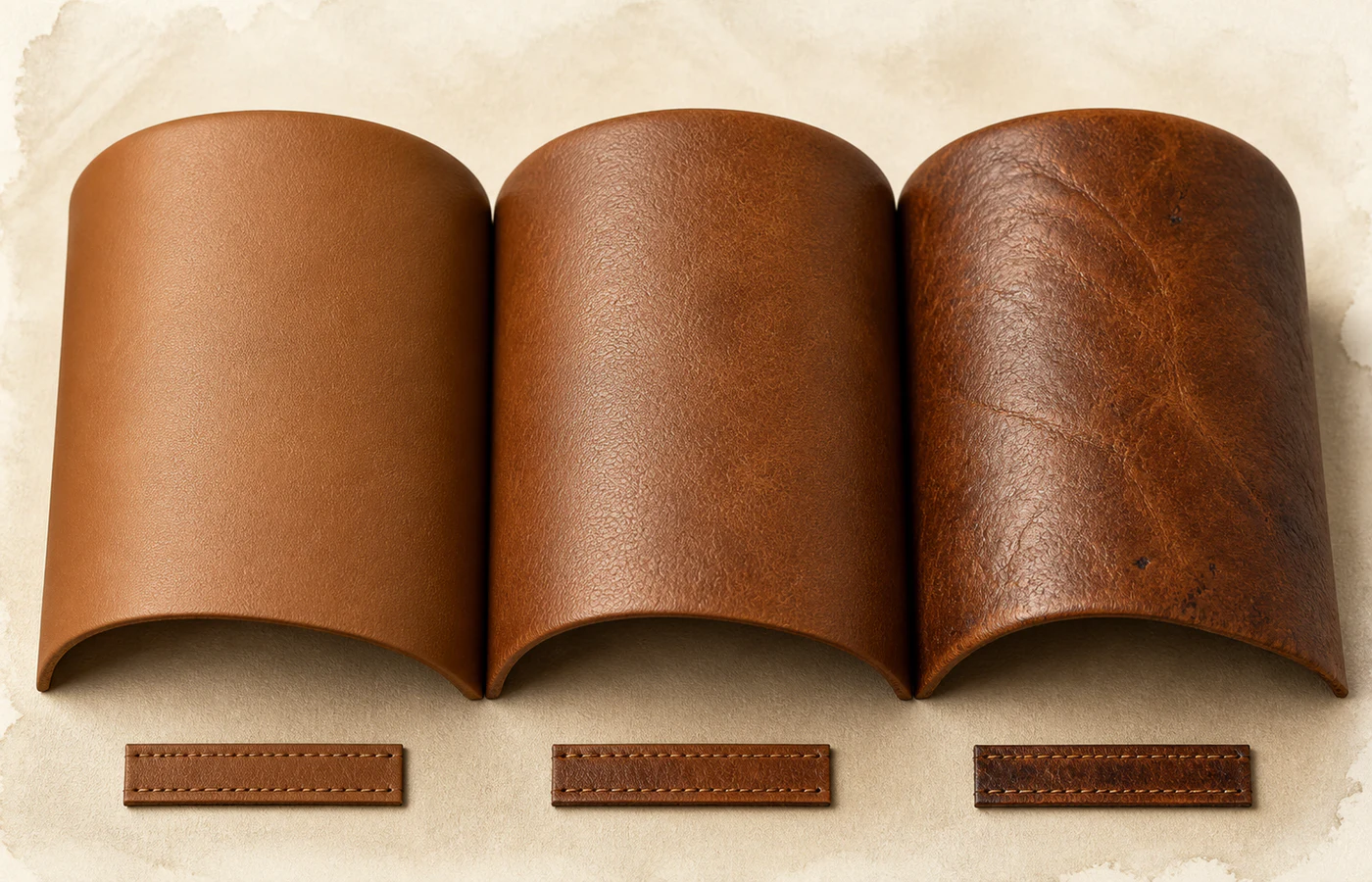
Surface protection decreases from protected leather to natural aniline, while visible grain and tonal variation increase.
Which leather is best for your household?
| Situation | Strong starting point | Conditional choice | Main caution |
|---|---|---|---|
| Young children | Protected top-grain or pigmented leather | Semi-aniline with clear care plan | Light aniline surfaces and food dyes |
| Dogs | Protected top-grain, medium color | Pull-up leather if scratches are welcomed | Soft aniline and exposed clawing |
| Cats | Fabric may be safer for active scratchers | Protected leather with scratch management | Any leather if scratching behavior is uncontrolled |
| Hot, humid room | Breathable real leather with ventilation and approved care | Protected leather | Bonded surfaces and heavy coatings of unknown quality |
| Direct sunlight | Pigmented leather plus blinds/film | Semi-aniline with careful placement | Natural aniline in uneven sun |
| Formal low-use room | Aniline or semi-aniline | Nubuck/pull-up | Paying for protection that is not needed |
| Rental or frequent moves | Protected leather or fabric | Leather match | Heavy premium sofa with difficult delivery route |
Climate, sunlight and air-conditioning
Leather is responsive to heat, moisture and dryness. Advice written for one climate should not automatically be applied to another.
- Keep the sofa away from strong direct sun where possible.
- Avoid continuous hot-air or cold-air flow directly onto the surface.
- Maintain room ventilation, especially in humid climates.
- Use only the cleaner and conditioner approved for the exact finish.
- Do not assume a fixed conditioning interval; over-conditioning can also create problems.
- Address spills promptly with the method specified by the manufacturer.
In tropical homes, the rapid shift between humid ambient air and air-conditioned dryness can be demanding. Ask the retailer how the exact leather and coating perform in local conditions, and request written guidance rather than relying on a generic care-kit sales pitch.
Panel coverage: the question most buyers forget
A product page may show a leather icon without explaining where leather is used. Request a panel map covering:
- seat cushions;
- inside back cushions;
- arm tops and inside arms;
- front rail;
- outside arms;
- rear panel;
- piping and hidden sections.
Also ask whether removable cushions use the same material on every side. A one-sided leather cushion may not be flippable.
Construction beneath the leather
Leather is expensive to replace, so the frame and cushions should justify the upholstery investment.
Frame and joinery
Look for specific material and joint descriptions. Kiln-dried hardwood and high-quality plywood can both be suitable when used correctly. Avoid assuming that “solid wood” automatically means strong construction.
Suspension
Sinuous springs, coil systems and webbing should be judged by gauge, spacing, attachment and serviceability. Sit at the center and edge; support should not collapse abruptly near the arms.
Cushions
Leather does not hide poor cushion recovery. Ask about foam density, wraps, pocket coils, reversibility and replacement inserts. Fixed seats may look tailored but are harder to rotate and repair.
Stitching and panel selection
Inspect straight seams, consistent tension, corner puckering and whether large high-visibility panels are positioned thoughtfully. Natural variation is expected; careless panel matching is not the same as character.
Showroom tests that reveal more than a label
- Sit for at least fifteen minutes in your normal posture.
- Slide across the seat to assess grip, heat and noise.
- Check whether the back pushes the head forward.
- Press and release every cushion to observe recovery.
- Lean on both arms and listen for movement.
- Compare a display model with a fresh swatch; the difference shows real aging.
- Inspect hidden back and side panels for material changes.
- Ask to see care instructions and warranty exclusions before paying.
Leather sofa red flags
- “Genuine leather” with no grade, finish or panel map.
- “Italian leather” used without explaining tannery, hide origin or manufacturing location.
- A full-leather claim that excludes sides and back in the fine print.
- Very low price combined with premium full-grain language.
- Generic household cleaner recommendations.
- No written care instructions for a costly surface.
- One-year structural warranty on a premium-priced sofa without explanation.
- Fixed cushions with no replacement route.
- Pressure to purchase before swatches or documentation are available.
Leather sofa buying checklist
- Hide category and finish written down separately
- Natural leather, bonded material and synthetic panels clearly identified
- Panel coverage map confirmed
- Swatch examined in home lighting
- Scratch, variation and patina expectations understood
- Approved cleaner and conditioner documented
- Sunlight and climate placement checked
- Frame, suspension and cushion construction reviewed
- Cushion and panel repair options confirmed
- Warranty exclusions for cracking, fading, stains and pets read
- Delivery route and total sofa weight checked
- Return rules for custom colors understood
Frequently asked questions
Is full-grain leather always the best sofa leather?
It is the least corrected grain layer and can be highly desirable, but the best household choice also depends on finish. A protected top-grain leather may be more practical than an unprotected full-grain aniline leather in a spill-prone room.
What is the difference between aniline and full grain?
Full grain describes the hide surface; aniline describes the dye and finish approach. A leather can be both full grain and aniline.
Does real leather peel?
Intact natural hide does not normally peel in the same way as a delaminating manufactured coating, but finishes can crack, coatings can fail, surfaces can flake under damage and poor-quality constructions can deteriorate. Ask what exactly is peeling before diagnosing the material.
Is leather good for pets?
Protected leather can be easy to wipe and does not trap hair like some textiles, but claws can leave permanent marks. It is a reasonable dog-household option when scratches are acceptable; it is risky with uncontrolled cat scratching.
How often should leather be conditioned?
Follow the current instructions for the exact finish. Some protected leathers need little conditioning; other surfaces require approved treatment. A generic schedule can lead to over-application or incompatible products.
Is leather match a scam?
Not when clearly disclosed and priced accordingly. The problem is incomplete labeling or implying that every visible surface is the same leather.
Final verdict
The strongest general-purpose leather sofa is usually not the most natural or the most heavily marketed. It is a protected top-grain or carefully specified semi-aniline sofa with transparent panel coverage, sensible care instructions and a frame worthy of reupholstery. Choose full-grain aniline for its evolving beauty only when your household genuinely welcomes marks, variation and maintenance.
Sources and verification notes
- CODA Complete Leather Sofa Buying Guidecoda.com.sgChecked August 6, 2026
- Casa Concetto Full-Grain Leather Sofa Guidecasaconcetto.sgChecked August 6, 2026
- Castlery Sofa Buying Guidecastlery.comChecked August 6, 2026
- The Spruce Sofa Buying Guidethespruce.comChecked August 6, 2026
- FTC Leather Guidesftc.govChecked August 6, 2026
Policies, prices, product specifications and availability can change. Reopen official product and policy pages before publishing a time-sensitive update or making a purchase.