Category Buying Guide
Best Fabric Sofa Types: An Evidence-Led Buying Guide for Real Homes
Compare eight fabric sofa upholstery types by durability, cleaning, comfort, snag risk, appearance and long-term ownership, with practical rankings for families, pets and everyday use.

On this page
Quick answerKey takeawaysFabric sofa rankings at a glanceHow we ranked fabric sofa types1. Tight-weave performance fabric — best overall2. Microfiber or microsuede — best for pets and easy cleanup3. Polyester and polyester-rich blends — best value4. Synthetic velvet — best for softness without loose loops5. Washable cotton-blend slipcovers — best for frequent spills6. Chenille — best cozy texture7. Natural linen and linen-rich blends — best relaxed appearance8. Bouclé and looped textures — best for low-traffic design impactChoose fabric by household, not by trendThe construction beneath the fabric still decides valueHow to test a fabric swatch at homeCleaning codes and removable-cover languageCommon fabric-sofa buying mistakesFabric sofa buying checklistFrequently asked questionsFinal verdictA fabric sofa is not one product category. A tightly woven polyester performance textile, a loose natural linen, a plush chenille and a looped bouclé can look equally inviting in photographs while behaving very differently around spills, sunlight, pet claws and daily compression. The useful question is therefore not simply “Which fabric is best?” but “Which construction and care profile best matches this household?”
Editorial status: This is a category ranking based on typical material behavior, published care guidance and practical ownership trade-offs. It does not rank individual products or claim hands-on testing. Exact performance depends on the specific textile, finish, backing, seam construction and manufacturer instructions.
Quick answer
For most busy households, a tightly woven performance fabric with clearly documented cleaning instructions is the strongest all-round choice. Microfiber is often the easiest budget-friendly option for hair and routine marks. Polyester blends usually offer the broadest combination of price, color and durability. Natural linen, chenille and bouclé can be attractive, but they require more acceptance of creasing, snagging, shading or specialist care.
The upholstery alone does not determine whether the sofa is a good purchase. Frame quality, suspension, cushion density, removable parts, warranty terms and delivery access matter just as much.
Key takeaways
- Start with household behavior—spills, pets, sunlight and cleaning tolerance—before choosing a texture.
- Treat “performance fabric” as a claim to verify, not a guaranteed grade.
- Compare abrasion with pilling, seam stability, fading, cleaning code and replacement-cover access.
- Dense flat weaves and microfiber are generally safer around claws than looped bouclé or loose linen.
- A durable textile still needs a sound frame, supportive cushions and realistic delivery access.
Fabric sofa rankings at a glance
| Rank | Fabric category | Best for | Main strength | Main compromise |
|---|---|---|---|---|
| 1 | Tight-weave performance fabric | Busy households | Balanced stain resistance and durability | Performance claims vary widely |
| 2 | Microfiber / microsuede | Pets, children and value buyers | Dense surface, easy hair removal | Can show pressure marks and body oils |
| 3 | Polyester or polyester-rich blend | Everyday value | Broad choice and low maintenance | Quality ranges from excellent to flimsy |
| 4 | Synthetic velvet | Softness without loose loops | Plush feel and relatively stable pile | Shading and pressure marks are visible |
| 5 | Washable cotton-blend slipcover | Frequent spills and flexible styling | Cover can be removed and replaced | Fit, shrinkage and laundering rules matter |
| 6 | Chenille | Cozy family rooms | Soft, dimensional texture | Some constructions snag or flatten |
| 7 | Natural linen or linen-rich blend | Relaxed, low-formality interiors | Breathability and natural texture | Wrinkling, staining and variation |
| 8 | Bouclé and other looped textures | Low-traffic design-led rooms | Strong visual texture | Highest snag and debris-trapping risk |
How we ranked fabric sofa types
The ranking weighs five questions more heavily than marketing names:
- How stable is the surface? Tight, short fibers usually resist snagging better than long loops or loose yarns.
- How clear is the care route? A sofa is easier to own when the cleaning code, approved products and removable-cover rules are explicit.
- How predictable is everyday wear? Pilling, shading, crushing, wrinkling and color transfer matter even when abrasion results look impressive.
- Can damaged parts be serviced? Replaceable cushion covers, inserts or modules can matter more than a very high rub-count claim.
- Does the material suit the household? Pets, children, direct sun, food, allergies and maintenance tolerance change the answer.
Abrasion numbers are useful screening data, but they are not lifespan guarantees. Wyzenbeek and Martindale results use different methods, and a high result does not automatically predict pilling, seam failure, snagging, staining or fading. Ask for the named test method and interpret it alongside the rest of the specification.
1. Tight-weave performance fabric — best overall
A well-specified performance fabric ranks first because it can combine a stable weave, stain-management finish, colorfastness and broad design choice. It is the category most likely to work in a living room that handles food, children, pets and frequent guests.
The term performance fabric is not a regulated quality grade. One retailer may use it for a solution-dyed synthetic with published test data; another may apply it to an ordinary polyester cloth with a topical treatment. Before paying a premium, ask for:
- exact fiber content;
- abrasion method and result;
- pilling and seam-slippage results where available;
- cleaning code and prohibited products;
- whether stain resistance comes from fiber construction or a surface treatment;
- whether the cover is removable, washable or replacement-only;
- warranty exclusions for stains, pets and normal wear.
Why it ranks first: it offers the best chance of balancing appearance, durability and practical cleaning.
Who should avoid it: buyers who want an untreated natural textile, are sensitive to particular finishes or expect every “performance” claim to mean machine-washable.
2. Microfiber or microsuede — best for pets and easy cleanup
Microfiber uses very fine synthetic fibers packed into a dense surface. The lack of large visible loops can make it harder for claws to catch than open weaves, while pet hair often sits on the surface rather than embedding deeply. Routine vacuuming and a suitable upholstery brush are usually straightforward.
Its drawbacks are visual rather than purely structural. The nap may change direction when touched, producing light and dark patches. Body oils can create darker zones on arms and head-rest areas. Some microfiber feels warm or less breathable than natural fabrics, especially on deep sofas.
Inspect the exact cleaning code. “Easy to clean” does not mean any household cleaner is safe. Test a swatch with water, lint, hair and the manufacturer-approved method before purchase.
Why it ranks second: strong practical performance at accessible prices.
Who should avoid it: buyers who dislike directional shading or want a crisp linen-like appearance.
3. Polyester and polyester-rich blends — best value
Polyester appears in many successful everyday upholstery fabrics because it resists wrinkling, is widely available and can be engineered into smooth, textured, velvet-like or linen-look surfaces. Blends may combine polyester stability with cotton softness or viscose sheen.
The category is broad. A dense, backed upholstery weave is not equivalent to a thin decorative cloth just because both contain polyester. Compare weight, weave density, backing, pilling resistance and seam performance. Look closely at sample edges: loose yarns and easy distortion can predict problems around seams and cushion corners.
Why it ranks third: it offers the widest useful middle ground of cost, color and maintenance.
Who should avoid it: buyers choosing solely from fiber percentages without seeing a full-size swatch.
4. Synthetic velvet — best for softness without loose loops
Velvet has a cut pile rather than the obvious loops found in bouclé. A durable synthetic velvet can therefore feel luxurious while presenting fewer claw-catching points than many highly textured fabrics. It also reflects light attractively and works well on tailored silhouettes.
The trade-off is visible movement. Sitting, brushing and pressure change the direction of the pile, creating temporary shading. Crumbs and dust can collect along seams. Pale velvet may show marks; dark velvet may show lint. Cleaning must follow the pile direction and the approved code.
Why it ranks fourth: it delivers a high-comfort, high-style surface with manageable practical limitations.
Who should avoid it: households that want a completely uniform, mark-free appearance.
5. Washable cotton-blend slipcovers — best for frequent spills
A true removable slipcover creates a different ownership model: the visible upholstery can be laundered, replaced or changed without reupholstering the whole sofa. This is useful for young children, vacation homes and buyers who prefer a relaxed look.
Do not confuse removable with machine-washable. Some covers must be dry-cleaned, spot-cleaned or professionally refitted. Ask whether all sections use zippers, whether covers are sold separately, whether washing can shrink or alter color, and whether replacement covers will remain available.
Cotton-rich cloth can wrinkle and may absorb spills quickly before cleaning. A blend usually improves dimensional stability.
Why it ranks fifth: excellent recovery from ordinary household mess when the laundering system is real and documented.
Who should avoid it: buyers who want taut tailoring and never want to refit covers.
6. Chenille — best cozy texture
Chenille yarn creates a soft, plush surface with subtle color depth. It can make a firm sofa feel visually warmer and is often comfortable against bare skin. Tighter chenille constructions may perform well in everyday rooms.
However, “chenille” describes the yarn, not the complete textile. Some versions have exposed fuzzy fibers that catch, flatten or show wear paths. The surface may trap lint and pet hair. Ask for pilling data, inspect a large swatch against the light and rub it repeatedly to see whether the pile separates or changes dramatically.
Why it ranks sixth: high comfort and visual richness, but more construction-dependent than the categories above.
Who should avoid it: homes with determined scratching cats or buyers who dislike pile shading.
7. Natural linen and linen-rich blends — best relaxed appearance
Linen is valued for texture, breathability and an informal drape. It suits rooms where natural variation and creasing are part of the desired look. A linen-polyester blend may retain some texture while improving recovery and stability.
Pure or high-linen fabrics can wrinkle, absorb liquid and show abrasion at sharp seams. Loose weaves can snag. Pale natural tones may reveal food, denim dye or body oils. A protected or blended linen-look textile may be more practical than untreated linen for an everyday family sofa.
Why it ranks seventh: beautiful and breathable, but less forgiving when the household expects pristine upholstery.
Who should avoid it: heavy-use homes that will interpret wrinkles and tonal variation as defects.
8. Bouclé and looped textures — best for low-traffic design impact
Bouclé creates its signature nubby surface through looped or curled yarns. That texture photographs well and can soften a minimal room, but the loops increase opportunities for snagging and debris accumulation. Quality varies widely: compact, tightly anchored loops are more stable than long, irregular ones.
Run a fingernail lightly across the swatch, press the loops apart and inspect the backing. If loops pull easily or large gaps open, the textile may be a poor fit for pets, jewelry, belts or daily food use.
Why it ranks eighth: strong aesthetic value but the least universally practical surface in this comparison.
Who should avoid it: cats that scratch, dogs that dig, households with frequent crumbs or anyone wanting simple lint removal.
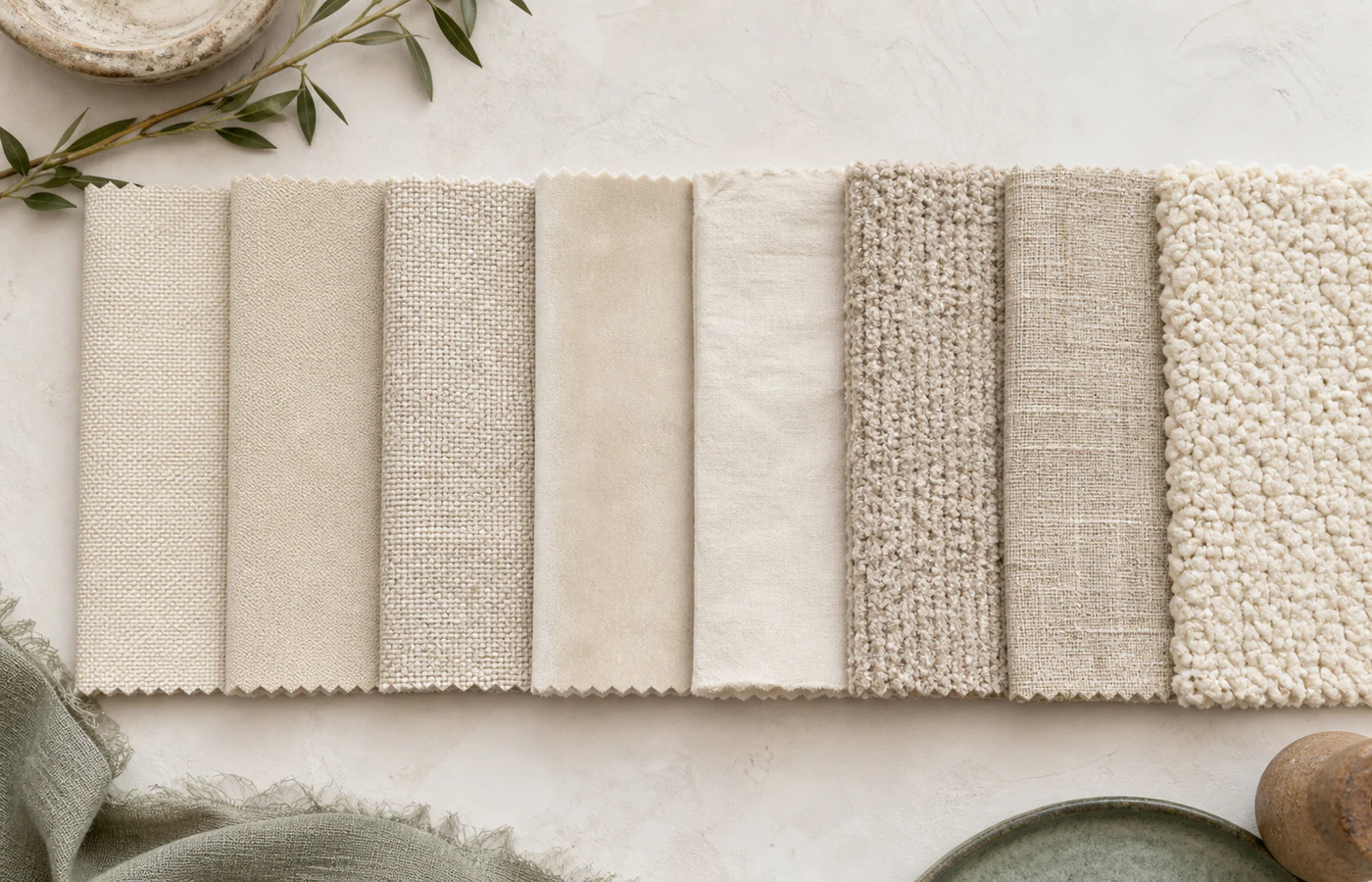
From smooth tight weaves to open looped textures, surface structure changes snag risk and cleaning effort.
Choose fabric by household, not by trend
| Household need | Strong starting point | Conditional option | Usually poor fit |
|---|---|---|---|
| Cats that scratch | Dense microfiber or tight flat weave | Protected leather if scratching is controlled | Bouclé, loose linen, open chenille |
| Large shedding dog | Microfiber or medium-tone performance weave | Synthetic velvet with frequent brushing | White loose weave with deep texture |
| Toddlers and food spills | Documented performance fabric or washable slipcover | Protected synthetic blend | Untreated linen or delicate velvet |
| Hot room | Breathable blend or linen-rich tight weave | Performance polyester with good ventilation | Heavy plush pile if heat-sensitive |
| Strong direct sun | Proven lightfast textile and window control | Medium-tone synthetic blend | Dark saturated natural dyes without guidance |
| Formal low-use room | Velvet, linen or bouclé | Tailored cotton blend | Any material chosen only for maximum durability |
| Allergy-sensitive household | Smooth, vacuum-friendly fabric with removable cushions | Washable cover system | Deep loose texture that traps debris |
The construction beneath the fabric still decides value
A visually durable textile can sit on a weak sofa. Evaluate the whole system:
Frame
Look for a clearly described timber, plywood or metal structure rather than vague language such as “premium wood.” Good joinery uses dowels, corner blocks, screws, bolts or engineered connectors in the correct locations; staples and glue may supplement a joint but should not be the only structural story.
Suspension
Sinuous springs, webbing and platform systems can all work when properly specified. Ask how the support is spaced, whether it is accessible for repair and whether the seat feels evenly supported at edges and center.
Cushions
Record the foam type, density if disclosed, wrap, reversibility and replacement policy. A very soft showroom cushion may compress quickly; a firm cushion may soften with use. Loose cushions that can be rotated generally wear more evenly than fixed seats.
Tailoring
Check whether seams run straight, patterns align, piping is consistent and corners are padded. Fabric failure often begins at poorly constructed seams rather than in the center of a cushion.
How to test a fabric swatch at home
A small sample cannot reproduce years of use, but it can expose obvious mismatches.
- View it in morning, afternoon and artificial light.
- Place it beside the rug, curtains, wall color and floor.
- Rub it with a dark and light cotton cloth to look for loose dye or lint transfer.
- Press pet hair, crumbs and ordinary household lint into the surface, then clean it using the intended tool.
- Bend and stretch the sample gently to inspect weave stability.
- Apply only the manufacturer-approved cleaning test to an edge.
- Leave it in the intended sunny location for several days and observe color shift.
- Keep the exact sample name and dye lot with the order documents.
Cleaning codes and removable-cover language
Common upholstery codes include W, S, W/S and X, but shoppers should use the manufacturer’s current instructions rather than relying on a generic internet interpretation. The same fiber can be treated differently depending on backing, dyes, finishes, cushion materials and flame-barrier construction.
Ask four separate questions:
- Can the cover be removed?
- Can it be machine-washed?
- Can it be dry-cleaned?
- Is a replacement cover available?
A “yes” to one does not imply a “yes” to the others.
Common fabric-sofa buying mistakes
Choosing by fiber name alone
“Polyester,” “linen” and “velvet” do not describe weave density, backing, finish or seam performance.
Treating abrasion as a lifespan promise
A high test result cannot predict every form of household wear.
Ignoring color and texture maintenance
Dark velvet may show lint; pale linen may show oils; bouclé may hide small marks but trap debris.
Assuming stain resistance means stain proof
Most spills still require prompt, approved treatment. Warranties commonly exclude misuse and permanent staining.
Forgetting replacement parts
A replaceable cover or cushion insert can be more valuable than a marginally higher fabric specification.
Buying before checking delivery
Measure doors, elevators, stairs, turns and packaging dimensions. A durable sofa that cannot enter the room is not a good purchase.
Fabric sofa buying checklist
- Exact textile name and fiber percentages recorded
- Full-size swatch viewed in the room
- Abrasion test method identified, not just a number
- Pilling, seam and lightfastness information reviewed where available
- Cleaning code and approved products saved
- “Removable” and “washable” confirmed separately
- Pet hair, lint and snag test completed on the swatch
- Frame and suspension specifications reviewed
- Cushion construction and replacement route confirmed
- Warranty exclusions read
- Return and custom-order rules understood
- Delivery route measured
Frequently asked questions
What is the best fabric for a sofa used every day?
A tightly woven performance fabric or a dense polyester-rich upholstery is the strongest starting point for most homes, provided the retailer publishes clear cleaning and construction information. The exact textile matters more than the marketing category.
Is a higher Martindale or Wyzenbeek result always better?
Not necessarily. The method, intended use and other tests matter. Abrasion does not directly measure pilling, stains, seam slippage, snagging or fading.
Is microfiber outdated?
Microfiber can look dated when paired with bulky silhouettes or shiny finishes, but modern matte versions remain practical. Judge the specific texture and sofa design rather than dismissing the category.
Is natural linen durable enough for a family sofa?
It can be, especially as a substantial blend, but it is usually less forgiving of stains, wrinkles and loose-weave snagging than a purpose-made performance textile. Families that like linen’s appearance may prefer a linen-look synthetic or removable slipcover.
Is bouclé pet friendly?
Usually not for pets that scratch or dig. Some compact bouclé is more stable than others, but looped yarns create more snag opportunities than a dense flat weave.
Should I pay more for machine-washable covers?
The feature is valuable when the cover truly fits after washing, all sections are removable and replacements remain available. Read the temperature, drying and refitting instructions before treating it as a major benefit.
Final verdict
The best fabric sofa is not the one with the softest showroom swatch or the largest abrasion number. It is the one whose weave, finish, cleaning route, color, cushions and frame match how the room is actually used. Start with a tight, well-documented performance textile for demanding daily life; move toward linen, chenille, velvet or bouclé only when their visual and tactile benefits outweigh the additional maintenance.
Sources and verification notes
- Castlery Sofa Buying Guidecastlery.comChecked August 6, 2026
- Belffin Which Sofa Fabric Fits Your Lifebelffin.comChecked August 6, 2026
- The Conran Shop Fabric Buying Guidetheconranshop.comChecked August 6, 2026
- Swyft Fabric Sofas Buying Guideswyfthome.comChecked August 6, 2026
- The Spruce Sofa Buying Guidethespruce.comChecked August 6, 2026
- ACT Voluntary Performance Guidelinescontracttextiles.orgChecked August 6, 2026
Policies, prices, product specifications and availability can change. Reopen official product and policy pages before publishing a time-sensitive update or making a purchase.