Category Buying Guide
Best Sofa Bed Types: Sleep Systems, Comfort and Conversion Ranked
Compare eight sofa bed and sleeper sofa types by sitting comfort, sleep surface, conversion effort, room clearance, mattress support and repairability.

On this page
Quick answerKey takeawaysSofa bed rankings at a glanceHow we ranked sofa bed types1. Integrated platform fold-out — best overall2. Pull-out mattress sleeper — best for regular guests3. Pop-up trundle sofa bed — best broad surface for couples4. Sectional sleeper with pull-out platform — best family-room hybrid5. Click-clack sofa bed — best budget studio choice6. Futon — best replaceable mattress system7. Daybed-style sofa — best single sleeper8. Chair-and-a-half or twin sleeper — best smallest footprintEvaluate the sleep surface like a bedEvaluate the closed sofa separatelyConversion effort and accessibilityOpen-footprint planningMattress materials and toppersFrame and mechanism serviceabilitySofa bed red flagsSofa bed buying checklistFrequently asked questionsFinal verdictA sofa bed must succeed at two jobs that often demand opposite construction. A comfortable everyday sofa needs supportive seat geometry and cushions; a useful guest bed needs a flat, adequately sized and well-supported sleep surface. A design that excels at one function can be disappointing at the other. Evaluate the sofa closed, the bed open and the conversion process as three separate products.
Editorial status: This ranking compares common conversion systems and use cases. It does not rank individual products or promise sleep quality. Actual dimensions, mattress materials and mechanisms must be confirmed from current specifications.
Quick answer
A platform-style fold-out sofa bed with an integrated foam sleep surface is the best all-round option for many homes because it avoids thin bar-and-mattress systems while remaining reasonably easy to convert. A traditional pull-out sleeper ranks second when the priority is a recognizable mattress and frequent overnight guests. Trundle and pop-up designs can create a large, even surface but need substantial floor clearance. Click-clack and futon designs are best for budget and occasional use rather than demanding daily sleep.
Key takeaways
- Test sofa mode, bed mode and conversion effort as three separate functions.
- Record the real sleeping width and length instead of relying on “queen” or “double” labels.
- Integrated platforms and quality pull-out systems are the strongest all-round starting points.
- Map the complete open footprint and decide where loose cushions and bedding will be stored.
- A replaceable mattress or serviceable mechanism can matter more than an impressive showroom transformation.
Sofa bed rankings at a glance
| Rank | Sofa bed type | Best for | Main strength | Main compromise |
|---|---|---|---|---|
| 1 | Integrated platform fold-out | Balanced sitting and occasional sleeping | Broad supported surface without a thin metal bed | Usually firm and mechanically specialized |
| 2 | Pull-out mattress sleeper | Regular overnight guests | Familiar mattress format and bed height | Heavy mechanism and possible bar pressure |
| 3 | Pop-up trundle sofa bed | Couples and large sleep surface | Creates a broad level platform | Large opening footprint and multiple seams |
| 4 | Sectional sleeper with pull-out platform | Family/media rooms | Combines lounging, seating and guest sleep | Very large and difficult to move |
| 5 | Click-clack / fold-down back | Studios and quick conversion | Simple, low-cost and compact | Center hinge and shallow sleep width |
| 6 | Futon frame and mattress | Flexible multipurpose rooms | Replaceable mattress and simple mechanism | Often less sofa-like and lower to floor |
| 7 | Daybed-style sofa | Single sleepers and home offices | Strong single-bed function with no mechanism | Limited conventional sofa posture |
| 8 | Chair-and-a-half / twin sleeper | Very small spaces | Compact occasional bed | Narrow sleep surface and high cost per seat |
How we ranked sofa bed types
The ranking considers:
- comfort and support in normal sofa mode;
- actual sleep dimensions, not marketing size labels;
- number and location of seams or bars;
- conversion effort and required strength;
- floor clearance when open;
- mattress or platform replacement;
- total furniture weight and delivery access;
- durability and serviceability of the mechanism;
- bedding storage and setup time.
A “queen sleeper” may not match a standard queen mattress in every market. Always record the actual sleeping width and length.
1. Integrated platform fold-out — best overall
This category unfolds seat and back sections into a supported foam platform rather than revealing a thin separate mattress on a metal frame. The mechanism may rotate or pull the seat forward while cushions become part of the sleep surface.
The main benefit is broad support with fewer exposed bars. The compromise is firmness and seams between sections. Check whether the upholstery itself forms the sleeping surface and whether a fitted protector can be used without interfering with conversion.
Why it ranks first: strongest balance of contemporary sofa comfort, conversion simplicity and useful guest sleep.
Who should avoid it: buyers who need to replace the sleep mattress independently or prefer a traditional spring mattress feel.
2. Pull-out mattress sleeper — best for regular guests
A pull-out sleeper stores a folded mattress and metal or engineered frame beneath the seat. It offers a familiar raised bed and makes it possible to compare mattress thickness and material.
Older designs are associated with thin mattresses and support bars. Better current versions use improved decking, webbing or platform structures, but the buyer must test the center and edges. The mechanism adds substantial weight and may make the sofa seat higher or firmer.
Why it ranks second: best route to a distinct bed function and replaceable mattress.
Who should avoid it: narrow stairs, users unable to lift the mechanism or rooms with insufficient opening clearance.
3. Pop-up trundle sofa bed — best broad surface for couples
A lower platform rolls or pulls from beneath the sofa and rises to seat height, combining with the seat to create a large sleep area. It avoids folding a mattress into several layers and can provide a generous rectangular surface.
The joins between seat and trundle may separate during the night. Verify locking, wheel stability and height alignment. The floor must be level and clear, and rugs can interfere with rolling.
Why it ranks third: efficient large sleeping area with relatively simple components.
Who should avoid it: thick rugs, uneven floors or rooms where the entire front area cannot remain clear.
4. Sectional sleeper with pull-out platform — best family-room hybrid
A sectional sleeper usually stores a platform under the main sofa section while the chaise provides the remaining length. It creates a large lounge or sleep surface and may include storage beneath the chaise.
The design is bulky and highly room-specific. The sleep surface may contain several cushion seams, and the chaise orientation is often fixed. Test whether sheets fit and whether two sleepers roll into gaps.
Why it ranks fourth: combines the most functions in one large room.
Who should avoid it: small apartments, frequent movers or anyone wanting a conventional flat mattress.
5. Click-clack sofa bed — best budget studio choice
A click-clack back folds flat through a simple ratcheting mechanism. Conversion is fast and there is no hidden mattress to lift. It is usually lighter and less expensive than a pull-out sleeper.
The sleep surface often has a hinge or valley down the center, and the sofa may be firm with a low back. Wall clearance may be required because the back folds rearward.
Why it ranks fifth: simple, compact and affordable for occasional use.
Who should avoid it: couples needing a wide surface or guests sensitive to center seams and firmness.
6. Futon — best replaceable mattress system
A futon uses one mattress that bends from sofa to bed position on a wood or metal frame. The mattress can often be replaced separately, which extends the useful life of the system.
Thick mattresses are harder to fold; thin ones can feel insufficient. Futons often sit low and offer less tailored sofa support. The frame mechanism must be easy to operate without trapping fingers.
Why it ranks sixth: straightforward serviceability and flexibility, offset by compromises in conventional sofa appearance.
Who should avoid it: users who need easy standing or want a polished living-room centerpiece.
7. Daybed-style sofa — best single sleeper
A daybed is essentially a single bed dressed as seating, sometimes with a trundle below. It has no daily conversion mechanism and can offer a stable mattress.
As a sofa, the seat is usually very deep and requires large back cushions. It works best against a wall in a home office, child’s room or guest room rather than as the main social sofa.
Why it ranks seventh: excellent bed, conditional sofa.
Who should avoid it: households needing ergonomic upright seating for several adults.
8. Chair-and-a-half or twin sleeper — best smallest footprint
A wide chair or compact loveseat may contain a narrow pull-out bed. It provides a guest option where a full sofa bed would not fit.
The sleep width is limited, the mechanism can make the chair heavy and the cost per seat is high. Verify that the actual user can sleep comfortably within the dimensions.
Why it ranks eighth: useful niche solution but least versatile overall.
Who should avoid it: couples or tall sleepers.
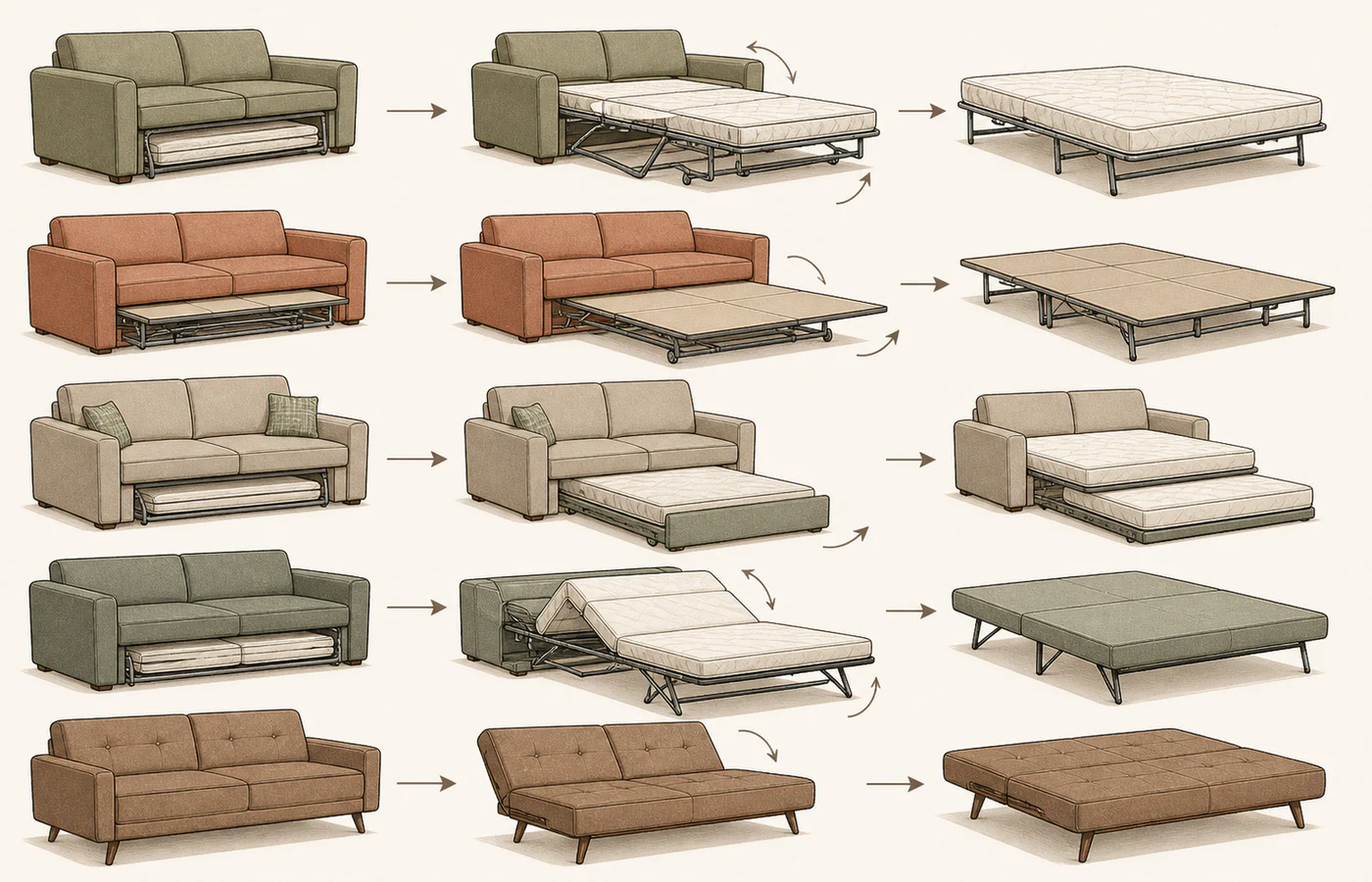
Sofa-bed mechanisms create different compromises in conversion effort, sleep-surface continuity, weight and serviceability.
Evaluate the sleep surface like a bed
Record:
- actual width and length;
- surface height from floor;
- mattress or foam thickness;
- support under shoulders, pelvis and heels;
- seams, hinges and bar locations;
- edge stability;
- weight limit;
- ventilation beneath the mattress;
- compatibility with protector and sheets.
Lie on the display in normal sleep positions. Sitters who share the bed should test it together because movement and center support change under combined load.
Evaluate the closed sofa separately
Hidden mechanisms alter sofa geometry. Check:
- seat height;
- usable seat depth after back cushions;
- firmness over the folded mechanism;
- weight of removable cushions;
- support at the front edge;
- noise when shifting position;
- whether the bed handle or frame can be felt through upholstery.
Do not accept poor everyday seating simply because the product includes a guest bed you use twice a year.
Conversion effort and accessibility
Perform the entire sequence without salesperson assistance:
- Remove and store loose cushions.
- Release the mechanism.
- Pull, lift or unfold each section.
- Lock the platform.
- Add bedding.
- Reverse the process.
Ask where cushions live overnight. A sofa bed that fills the room with loose cushions creates another storage problem.
Users with limited strength should pay special attention to pull-out frame weight and low futon mechanisms. Powered conversion can reduce effort but adds motors and service needs.
Open-footprint planning
Tape the sofa in both modes. Include:
- bed length;
- room to walk beside it;
- access to doors and wardrobes;
- bedside table or phone placement;
- curtain and radiator clearance;
- room to stand while making the bed;
- emergency exit routes.
A sofa bed can technically open while making the room unusable. Decide whether that is acceptable for one night or frequent guests.
Mattress materials and toppers
Common sleep surfaces include polyurethane foam, memory foam, innerspring, pocket spring, latex blends and upholstered platform cushions. No material is universally best. Compare thickness, density where disclosed, temperature, edge support and replacement availability.
A topper can soften seams or bars but creates storage and may prevent the mechanism from closing. Never fold extra bedding inside the sofa unless the manufacturer explicitly permits it.
Frame and mechanism serviceability
Ask:
- who manufactured the sleeper mechanism;
- whether replacement parts are stocked;
- whether the mattress is a standard or proprietary size;
- how technicians access the frame;
- whether the sofa separates for delivery;
- which warranty covers frame, mechanism and mattress;
- whether labor and transport are included.
Open and close the display several times. Movement should be symmetrical, controlled and free from scraping.
Sofa bed red flags
- Only a marketing size such as “queen” is listed.
- No open dimensions or room-clearance diagram.
- Mattress thickness is omitted.
- Bed cannot be tested in store.
- Metal bar or hinge is obvious through the sleep surface.
- Conversion requires lifting more weight than the user can manage.
- Loose cushions have no overnight storage plan.
- Replacement mattress uses an undisclosed proprietary size.
- Mechanism warranty is shorter than expected without service options.
- Custom sleeper is non-returnable before the buyer tests the system.
Sofa bed buying checklist
- Actual sleep width and length recorded
- Sofa mode tested for at least fifteen minutes
- Bed mode tested in normal sleep positions
- Center seam, bars and edge support checked
- Full opening footprint taped
- Conversion completed without assistance
- Cushion and bedding storage planned
- Mattress/protector compatibility confirmed
- Mechanism and replacement parts documented
- Weight and delivery route checked
- Separate warranties compared
- Return rules understood
Frequently asked questions
What is the most comfortable type of sofa bed?
For many occasional guests, an integrated platform or well-designed pull-out mattress system offers the best balance. Comfort still depends on actual dimensions, support and individual preference.
Is a sofa bed suitable for everyday sleeping?
Some are designed for frequent or daily sleep, but many are not. Confirm the manufacturer’s intended use, mattress replacement route, ventilation and warranty before using one as a primary bed.
Is a sleeper sofa the same as a sofa bed?
Retailers use the terms inconsistently. “Sleeper sofa” often means a hidden pull-out mattress, while “sofa bed” may include fold-flat and platform designs. Evaluate the mechanism rather than the label.
Can I add a mattress topper?
Usually for sleeping, yes, if it fits and is stored separately. Do not close the mechanism with a topper inside unless the manufacturer approves it.
How much room does a sofa bed need?
Use the exact open length plus circulation and setup space. A pull-out bed may project far beyond the closed sofa depth.
Are sofa beds difficult to move?
Many are very heavy because of the mechanism. Check whether backs, arms or sleeper frames detach and whether the delivery team handles stairs.
Final verdict
The best sofa bed treats sitting, sleeping and conversion as equally serious functions. Integrated platform systems rank first for balanced occasional use, while pull-out mattress sleepers remain the stronger choice for regular guests who want a distinct bed. Buy from dimensions and mechanism details, not from the words “queen sleeper” or a perfectly styled photograph.
Sources and verification notes
- King Living Sofa Bed Buying Guidekingliving.comChecked August 6, 2026
- Sterling Home Sofa Bed Buying Guidesterlinghome.co.ukChecked August 6, 2026
- Castlery Sofa Buying Guidecastlery.comChecked August 6, 2026
- The Spruce Sofa Buying Guidethespruce.comChecked August 6, 2026
Policies, prices, product specifications and availability can change. Reopen official product and policy pages before publishing a time-sensitive update or making a purchase.