Category Buying Guide
Best High-Back Sofa Types: Support, Proportions and Room Fit Ranked
Compare eight high-back sofa designs by neck and shoulder support, seat geometry, visual scale, accessibility, maintenance and room placement.

On this page
Quick answerKey takeawaysHigh-back sofa rankings at a glanceHow we ranked high-back sofa types1. Medium-high structured back — best overall2. Adjustable-headrest sofa — best for mixed-height households3. High tight-back sofa — best for upright sitting4. Wingback or shelter-back sofa — best for enclosure and visual presence5. Loose-cushion high back — best relaxed family option6. High-back reclining sofa — best for media rooms7. Compact high-back loveseat — best narrow reading seat8. Extra-deep cloud-style high back — best only for sprawlingHigh back versus low backMeasure effective back height, not only overall heightThe five-minute and thirty-minute testsRoom-placement rankingStyling a high-back sofa without making the room heavyFabric and cushion considerationsAccessibility and standingHigh-back sofa red flagsHigh-back sofa buying checklistFrequently asked questionsFinal verdictA tall backrest does not automatically create useful head, neck or shoulder support. The sitter’s height, seat depth, seat height, back angle, cushion compression and lumbar shape determine where the body actually contacts the sofa. Some high-back designs support an upright reader; others push the head forward or leave the shoulders unsupported despite an impressive overall height.
Editorial status: This ranking compares high-back sofa designs by typical geometry and use. It is not medical advice and does not claim ergonomic testing of individual products. Comfort must be assessed by the actual users in realistic sitting positions.
Quick answer
A medium-high sofa with a stable tight back or structured cushions is the most versatile high-back design. It can support shoulders without visually overwhelming the room or forcing every sitter into one head position. Adjustable-headrest sofas rank highly for mixed-height households, while traditional wingback and fixed head-cushion designs suit narrower use cases. Very deep, heavily padded high backs can feel luxurious but often undermine upright support.
Key takeaways
- Measure support from the compressed seat, not only the sofa’s floor-to-top height.
- A medium-high structured back is more versatile than an oversized fixed head cushion.
- Seat depth, lumbar shape and back angle can matter more than total back height.
- Tape the vertical outline against windows, switches and sightlines before buying.
- Every regular user should test upright sitting, relaxed viewing and standing from the seat.
High-back sofa rankings at a glance
| Rank | Design type | Best for | Main strength | Main compromise |
|---|---|---|---|---|
| 1 | Medium-high structured back | Everyday mixed use | Balanced support and room scale | May not support the tallest user’s head |
| 2 | Adjustable-headrest sofa | Mixed heights and TV viewing | Customizable upper support | Moving hardware and visual complexity |
| 3 | High tight-back sofa | Reading and upright sitting | Stable contact and tidy appearance | Less sink-in softness |
| 4 | Wingback or shelter-back sofa | Cozy reading zones and large rooms | Side enclosure and visual presence | Can block sightlines and feel formal |
| 5 | Loose-cushion high back | Relaxed family rooms | Adaptable softness and replaceable cushions | Cushions migrate and need plumping |
| 6 | High-back reclining sofa | Media rooms and assisted lounging | Support changes with recline angle | Mechanism, weight and clearance |
| 7 | Compact high-back loveseat | Small reading rooms | Full upper support in a narrow width | Can look vertically heavy |
| 8 | Extra-deep cloud-style high back | Dedicated lounging | Cocooning comfort | Weak upright posture and difficult standing |
How we ranked high-back sofa types
The ranking prioritizes:
- effective support measured from the compressed seat, not floor height;
- compatibility with different body heights;
- neutral head position rather than forced forward flexion;
- seat depth and seat height;
- stability of cushions over time;
- visual scale, windows and sightlines;
- ease of standing;
- maintenance and replacement of upper cushions.
The same backrest can work differently after a seat cushion softens. Evaluate the full seated geometry, not one catalog dimension.
1. Medium-high structured back — best overall
A medium-high sofa supports the shoulder blades and upper back while avoiding the visual bulk of a full head-height wall. A structured tight back or dense attached cushion keeps the support surface predictable.
This design works well for conversation, reading and everyday television because it does not require every sitter’s head to land on a fixed cushion. Taller people can add a loose head pillow; shorter people are less likely to be pushed forward.
Why it ranks first: broadest compatibility across bodies, activities and room sizes.
Who should avoid it: buyers who require continuous head support without adding a pillow.
2. Adjustable-headrest sofa — best for mixed-height households
Adjustable headrests can fold down for a low-profile appearance and rise for TV viewing or reclining. They are particularly useful when one user needs upper support and another dislikes a fixed tall back.
Inspect the mechanism carefully. The headrest should lock securely, move without pinching and remain comfortable at intermediate positions. Check whether replacement hardware is available and whether the folded edge creates a hard ridge.
Why it ranks second: the best solution to differing torso and neck positions.
Who should avoid it: buyers wanting a mechanically simple sofa or a traditional appearance.
3. High tight-back sofa — best for upright sitting
A tight-back sofa integrates the upholstered back directly into the frame. It does not require loose cushions to maintain height or alignment, so support remains more consistent. The silhouette is clean and the seat may offer more usable depth because no thick back pillows intrude.
The firmness can expose a poor back angle. Sit for an extended period and check whether the lumbar area is supported or hollow. A decorative button or seam should not create pressure at the spine.
Why it ranks third: stable, low-maintenance support for reading and conversation.
Who should avoid it: buyers who want to sink deeply or rearrange back cushions.
4. Wingback or shelter-back sofa — best for enclosure and visual presence
Wingback sofas extend the back or side panels around the sitter. This can create a quiet, cocooning feeling and help define a seating zone in an open room. The vertical form also balances high ceilings.
The wings can limit side conversation, block light or make a compact room feel divided. Check whether the wing sits near the head and whether it interferes with arm movement.
Why it ranks fourth: strong emotional and spatial value in the right room, but less universally flexible.
Who should avoid it: small rooms, window placement behind the sofa or layouts requiring open cross-room views.
5. Loose-cushion high back — best relaxed family option
Large back cushions can provide a soft, forgiving surface and can often be replaced or restuffed. Users may add or remove cushions to adjust seat depth and upper support.
The drawback is maintenance. Tall loose cushions slump, separate and compress, changing the effective height. Feather-rich fillings require regular plumping; light cushions may fall forward when the sitter stands.
Why it ranks fifth: comfortable and serviceable, but less geometrically stable.
Who should avoid it: buyers wanting a consistently tailored look with minimal upkeep.
6. High-back reclining sofa — best for media rooms
A recliner changes the relationship between seat, back, head and legs. A headrest that feels too prominent upright may become appropriate when reclined. Power headrests can maintain a forward viewing angle while the body leans back.
Assess every position. Some designs support the head only at full recline; others create a gap behind the neck. Check footrest length, lumbar shape, fully open depth and pinch points.
Why it ranks sixth: excellent specialized support, balanced against mechanical complexity.
Who should avoid it: households needing light furniture, easy relocation or a simple non-electrical sofa.
7. Compact high-back loveseat — best narrow reading seat
A high-back loveseat can provide strong upper support without the width of a full sofa. It suits bedrooms, libraries and compact sitting rooms.
Vertical bulk matters more when width is narrow. Slim arms, visible legs and a restrained back shape help prevent the piece from looking like a large chair stretched sideways.
Why it ranks seventh: useful niche solution, but less flexible as a main household sofa.
Who should avoid it: households needing three true seats or broad lounging space.
8. Extra-deep cloud-style high back — best only for sprawling
Some deep sofas pair tall loose backs with very soft seats. The height creates a cocooning photo, but the body may sit far from the back unless several pillows are added. Shorter users can lose foot contact and slump through the pelvis.
Why it ranks eighth: exceptional for curling up, weak for upright versatility and easy standing.
Who should avoid it: users with limited mobility, formal sitters or anyone who wants feet-flat posture.
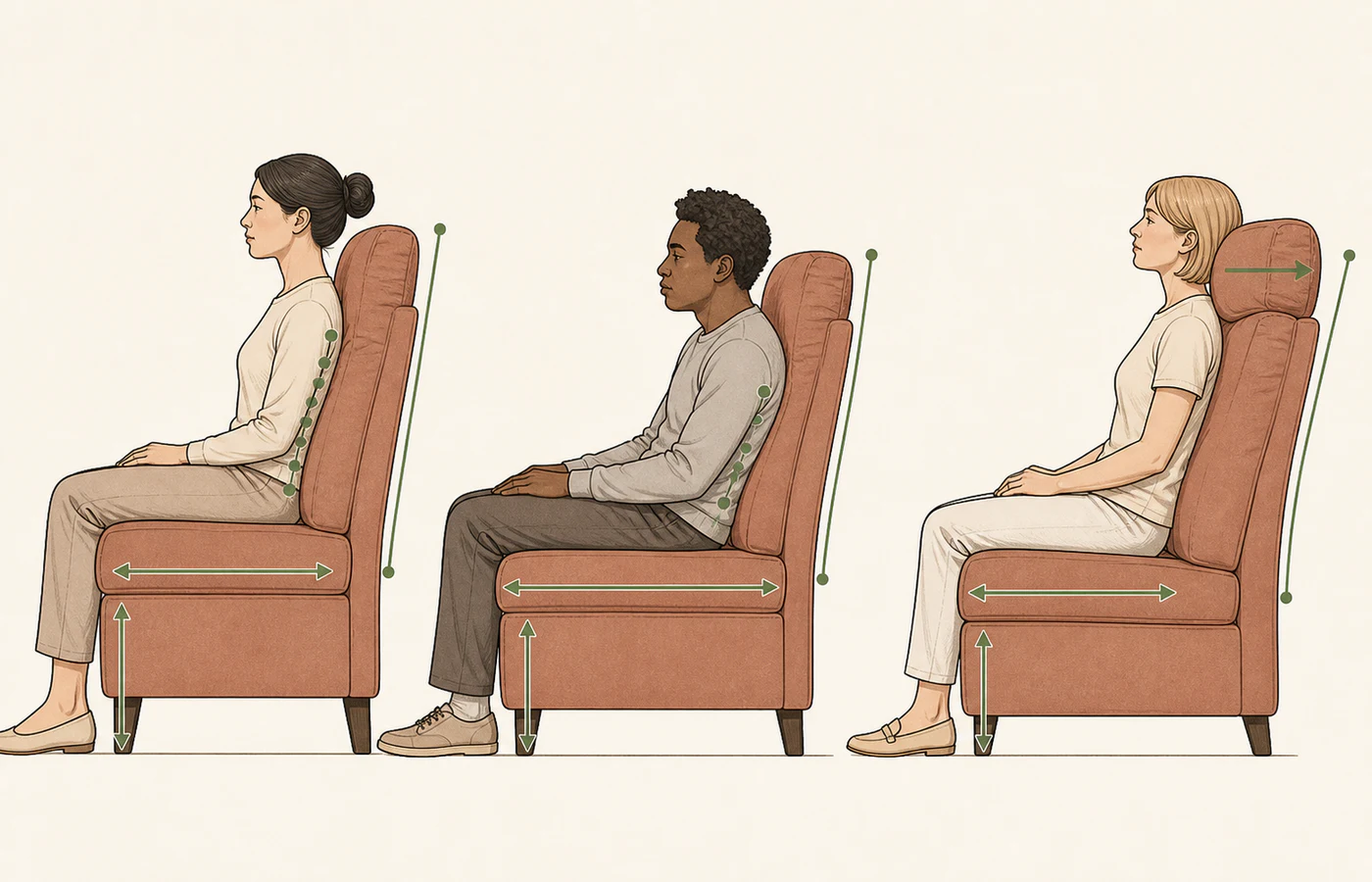
Back height supports the sitter only when seat depth, compressed seat height and cushion angle also fit the body.
High back versus low back
| Question | High-back sofa | Low-back sofa |
|---|---|---|
| Upper-body contact | Can support shoulders and head | Usually ends below shoulders |
| Visual effect | Anchoring, enclosed, substantial | Open, horizontal, contemporary |
| Window placement | More likely to block sill or view | Easier below windows |
| Conversation | Can feel private or divided | Keeps sightlines open |
| Tall room | Helps fill vertical scale | May look undersized without wall art |
| Small room | Needs slim form and careful placement | Usually visually lighter |
| Maintenance | More cushion/fabric surface | Less vertical upholstery |
| Best activity | Reading, TV, resting | Social sitting, open layouts |
Neither category is inherently more comfortable. A low sofa with correct lumbar support can outperform a tall back with poor seat geometry.
Measure effective back height, not only overall height
Overall sofa height includes legs, frame and uncompressed cushions. Effective support should be assessed from the top of the compressed seat to the point where the back makes useful contact.
Record:
- floor-to-seat height under body weight;
- compressed seat depth;
- seat-to-shoulder height for each user;
- seat-to-back top height;
- headrest projection;
- back angle;
- lumbar contact point.
A showroom ruler cannot replace sitting, but these measurements help explain why two equally tall sofas feel different.
The five-minute and thirty-minute tests
Five-minute test
- Sit with feet flat and back against the sofa.
- Check whether knees are level with or slightly below hips.
- Notice whether the head is forced forward.
- Place arms naturally; shoulders should not rise.
- Stand without using excessive momentum.
Thirty-minute test
- Read, use a phone and watch a screen.
- Shift from upright to relaxed posture.
- Check heat, pressure and cushion movement.
- Ask whether a pillow is required and where it would live.
- Repeat with every primary household user.
A sofa that impresses for two minutes may become tiring over a full film.
Room-placement ranking
Best placement: against a solid wall
A tall sofa usually feels most resolved against the room’s longest uninterrupted wall, provided it does not crowd art or controls.
Good placement: zoning an open plan
A high back can separate living and dining areas, but the rear upholstery must be fully finished and the circulation route must remain generous.
Conditional placement: in front of a window
Check sill height, curtains, handles, ventilation and daylight. Tape the full sofa height on the wall before purchase.
Poor placement: across the main sightline
A tall back can act like an unintended partition between entry, kitchen, television or view.
Styling a high-back sofa without making the room heavy
- Pair it with a low coffee table.
- Use leggy side tables and chairs rather than more bulky furniture.
- Keep wall art proportionate to the sofa’s height.
- Avoid stacking oversized cushions over an already tall back.
- Use visible legs or a recessed base in a small room.
- Repeat one upholstery color elsewhere rather than adding many competing patterns.
- Light the upper wall so the back does not read as a dark block.
Fabric and cushion considerations
A high back contains more vertical upholstery, making pile direction, pattern matching and fading more visible. Large loose cushions can create shadow lines and color variation. If the sofa sits near a window, ask for lightfastness information and use window control.
For removable covers, confirm that the extra back height is included in replacement-cover sizing. Generic stretch covers often pull upward or bunch around wings and headrests.
Accessibility and standing
People with limited knee strength often benefit from:
- moderate seat height;
- shallower effective depth;
- firm cushions;
- supportive arms;
- clear floor space for the feet.
A high back alone does not improve standing. Extra-deep seats and soft cushions can make rising harder even when upper support feels excellent.
High-back sofa red flags
- Manufacturer lists overall height but not seat height or depth.
- Head cushion presses the chin toward the chest.
- Tall back ends below the user’s shoulder blades despite its appearance.
- Loose upper cushions collapse after brief use.
- Sofa blocks a window, switch or radiator in the taped layout.
- Display model requires several decorative pillows to feel usable.
- Back looks finished from front only despite floating-room placement.
- Replacement headrest hardware or cushions are unavailable.
High-back sofa buying checklist
- Every regular user tested the sofa
- Compressed seat depth and height checked
- Shoulder and head contact noted
- Upright and relaxed postures tested
- Standing effort assessed
- Full height taped against wall/window
- Sightlines and daylight checked
- Cushion fill and replacement route confirmed
- Adjustable hardware tested through all positions
- Upholstery lightfastness and care reviewed
- Delivery height and removable legs/back checked
- Rear finish inspected if sofa will float in room
Frequently asked questions
Is a high-back sofa better for back pain?
Not automatically. Comfort depends on the entire posture and individual needs. A high back may support shoulders and head, but excessive depth, soft cushions or a poor lumbar curve can still be uncomfortable. Seek qualified health advice for persistent pain.
What height counts as a high-back sofa?
Retailers use the term inconsistently. Compare seat-to-back height and actual body contact rather than relying on one floor-to-top threshold.
Can a high-back sofa work in a small room?
Yes, when it has slim arms, visible legs, moderate depth and a simple silhouette. Tape its height as well as footprint to judge visual volume.
Are high-back sofas old-fashioned?
No. Tight-back, channelled and adjustable-headrest designs can look contemporary. Bulky rolled arms and oversized cushions create a more traditional effect.
Is a high back good for tall people?
It can be, but many “high” backs still end below a tall user’s head. Test the actual seat because cushion compression and depth change the contact point.
Should a high-back sofa sit against a wall?
Often, but not always. It can zone an open plan when the rear is finished and sightlines remain acceptable.
Final verdict
The best high-back sofa is not the tallest one. A medium-high structured back ranks first because it supports the upper body without forcing a fixed head position or overwhelming most rooms. Adjustable headrests are the best choice for mixed heights. Choose extra-tall, winged or deep designs only after testing the actual body fit and mapping their vertical presence in the room.
Sources and verification notes
- The Sofa Cover Crafter High-Back Sofa Guidethesofacovercrafter.co.ukChecked August 6, 2026
- Ovios High-Back vs Low-Back Sofa Guideovios-home.comChecked August 6, 2026
- Castlery Sofa Buying Guidecastlery.comChecked August 6, 2026
- The Spruce Sofa Buying Guidethespruce.comChecked August 6, 2026
Policies, prices, product specifications and availability can change. Reopen official product and policy pages before publishing a time-sensitive update or making a purchase.