Sofa comparison
High-Back vs Low-Back Sofa: Which Is More Comfortable and Better for Your Room?
Compare high- and low-back sofas by shoulder and head support, posture, seat geometry, room scale, window sightlines, cleaning, styling and mobility needs.

On this page
Quick verdictAt-a-glance comparisonWhy this question has a real search windowMeasure effective support, not catalog heightSeat depth can cancel a tall backHead and neck postureSightlines and room zoningStanding and mobilityCushion maintenanceMatch height to room scaleBest choice by household and use caseA practical room-and-body mock-upA repeatable showroom and swatch testCommon buying mistakesPre-purchase checklistFrequently asked questionsFinal decision ruleOverall height is easy to compare and easy to misunderstand. What the body experiences is support height above the compressed seat, combined with back angle, cushion thickness and seat depth. A tall frame can leave the head unsupported, while a low frame with generous loose cushions may reach the shoulder blades.
How to use this guide: Retail labels are inconsistent. Compare the exact dimensions, materials, mechanism, care instructions and current policies of the product you are considering. The recommendations below are decision rules rather than universal promises.
Quick verdict
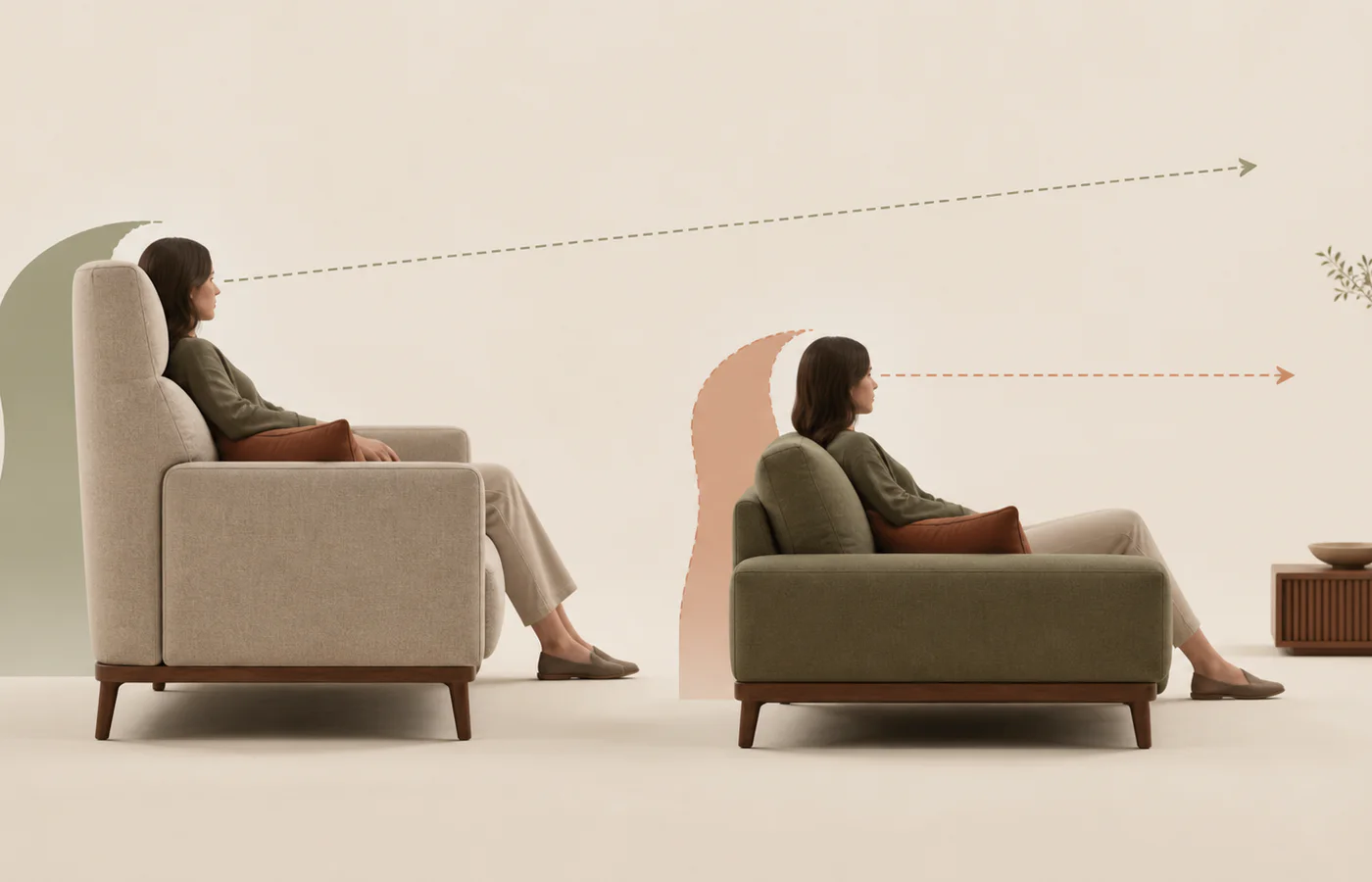
Choose a high back for reliable upper-body contact, a more enclosed feel and long upright sessions, provided it does not push the head forward. Choose a low back when preserving windows, artwork and open-plan sightlines is more important and movable pillows can supply individual support.
At-a-glance comparison
| Decision factor | High-back sofa | Low-back sofa |
|---|---|---|
| Upper-body contact | More potential shoulder and head support | Often ends below shoulders unless cushions extend it |
| Visual scale | Anchoring, enclosing and visually heavier | Open, architectural and visually lighter |
| Window placement | More likely to block sill or view | Often easier beneath windows |
| Posture | Can support upright reading and conversation | Often paired with lounging and movable pillows |
| Maintenance | Tall loose cushions may need resetting | Cleaner line, but extra pillows may be needed |
| Mobility | Upper support can help settle upright | Low profiles often pair with low seats |
| Style | Traditional, winged or cocooning | Modern, platform and open-plan friendly |
Why this question has a real search window
This is a narrower long-tail than leather versus fabric, but current 2026 results show active ergonomics and room-scale interest. The article earns its place by answering a specific buyer regret: selecting visual height without understanding effective support, seat depth and window obstruction.
Measure effective support, not catalog height
Sit until the seat and back cushions compress, then note contact at the pelvis, lumbar area, shoulder blades and head. Overall height includes legs and seat deck and may exaggerate the useful back. Photograph the sitter from the side. A thick upper cushion that pushes the chin forward is not good support simply because it reaches the head.
Seat depth can cancel a tall back
A shorter sitter may not reach a high back when the seat is deep. They slide forward, lose lumbar contact and add pillows. A tall sitter may reach the frame but still need more shoulder support. Test depth and height as one geometry. For mixed households, movable lumbar and head pillows can be more adaptable than one fixed contour.
Head and neck posture
Useful head support meets the lower head without forcing it forward. Overfilled vertical cushions can create neck flexion during reading or screen use. A gently angled back or adjustable headrest may work better. Low backs are not automatically poor for posture. They can support the pelvis and lower back while a separate pillow serves the shoulders. The question is whether the user wants to arrange that support every time.
Sightlines and room zoning
Tape the loaded height, including cushions, on the wall or window. Check the view from the entry, dining table and adjacent room. A high back can intentionally zone an open plan, but it can become a visual wall in a compact apartment. Low backs expose more wall and can make ceilings feel taller. Their light appearance does not guarantee a small footprint; many are exceptionally deep.
Standing and mobility
Back height is not the main determinant of standing. Seat height, softness, depth and stable arms matter more. Low-back designs are often low-slung, while a high-back sofa can still be difficult if the seat collapses. Test sitting, remaining upright and standing repeatedly. Furniture guidance should not replace individualized clinical advice where pain or mobility is involved.
Cushion maintenance
High loose backs often use fiber or feather-rich cushions that need fluffing and rotation. Fixed backs hold a clean shape but can be difficult to service when foam weakens. Low tight backs require less resetting, but households often accumulate pillows to compensate. Include those pillows in the real maintenance and visual plan.
Match height to room scale
A high back can balance a tall wall or fireplace and create an enclosed seating zone. Control width, arms and color contrast in a small room. A low back works well when floating in a room or sitting beneath a window. Add vertical interest through lighting, art or plants so the room does not feel flat.
Best choice by household and use case
| Situation | Better starting point | Why |
|---|---|---|
| Upright reader | High back with correct head angle | Continuous shoulder support |
| TV lounger | Either; prioritize angle and depth | Head and foot position decide more |
| Sofa beneath a window | Low back | Preserves sill, light and view |
| Open-plan divider | Low for connection; high for zoning | Choose the intended degree of separation |
| Tall household | High effective back with suitable depth | Test actual contact |
| Mixed body sizes | Moderate back with movable support | More adaptable than one fixed shape |
| Mobility concerns | Higher firmer seat with stable arms | Do not use back height as the proxy |
A practical room-and-body mock-up
A back-height decision should be tested twice: once on the body and once in the room. For body fit, sit until the cushion compresses and have another person mark the height of the pelvis, shoulder blades and back of the head against a wall. Compare those contact points with the sofa’s effective upholstered support—not only its total height including legs.
For room fit, place painter’s tape at the proposed sofa height across a wall or window. View it from the entry, dining area and the opposite side of an open plan. A few inches can determine whether the sofa feels cocooning or visually blocks the room.
| Observation | What to investigate |
|---|---|
| Head is pushed forward | Upper cushion may be too thick or upright |
| Shoulders float away from the back | Seat may be too deep to reach the support |
| Low back feels comfortable with a pillow | Movable support may be the better compromise |
| Window sill sits below the taped line | Confirm view, curtain and opening clearance |
| High back improves zoning | It may intentionally divide living and dining areas |
Also test the sofa without showroom throw pillows. If it only feels supportive after a carefully staged pillow arrangement, decide whether the household will recreate that arrangement every day.
A repeatable showroom and swatch test
Use the same sequence for every shortlisted model so a persuasive salesperson or attractive room photograph does not reset the criteria:
- Photograph the full specification and price, including the exact upholstery, fill and configuration.
- Measure the loaded seat depth, seat height, back contact point and usable width.
- Sit upright for at least ten minutes, lounge in the household’s normal posture and repeat the stand-up motion.
- Test the least comfortable-looking position: a connector seam, center seat, corner, front edge or mechanism transition.
- Recreate the full footprint at home with tape, including open or converted dimensions where relevant.
- Price delivery, assembly, returns, replacement covers or cushions and the likely repair route.
- Save screenshots or PDFs of date-sensitive policies before placing the order.
Common buying mistakes
- Comparing overall height without seat compression.
- Assuming high automatically means head support.
- Ignoring seat depth and back angle.
- Choosing a low silhouette without checking low seat height.
- Forgetting loose high cushions need maintenance.
- Failing to mock up window obstruction.
Pre-purchase checklist
- Effective seated back height tested.
- Head-forward pressure checked.
- Depth and height suit shortest and tallest users.
- Window and open-plan sightlines mocked up.
- Standing effort tested.
- Loose-cushion maintenance accepted.
- Replacement back inserts confirmed.
- Overall visual mass checked.
Frequently asked questions
How high should a sofa be for head support?
There is no universal number because torso length, compression and angle change the contact point.
Is a low-back sofa bad for posture?
Not automatically. Good pelvic and lumbar support can come from the lower geometry and movable pillows.
Do high backs make rooms look smaller?
They can add visual mass, especially across windows. Width, arms, depth and color also matter.
Which is easier for older adults?
Usually a firmer moderately high seat with stable arms and manageable depth, not simply the tallest back.
Can I add head support to a low sofa?
Sometimes, with stable pillows or designed headrests that do not push the neck forward.
Final decision rule
Choose a high back for reliable upper-body contact, a more enclosed feel and long upright sessions, provided it does not push the head forward. Choose a low back when preserving windows, artwork and open-plan sightlines is more important and movable pillows can supply individual support.
Sources and verification notes
- Vintage Sofa — High-Back vs Low-Back Sofasvintagesofa.co.ukChecked August 6, 2026
- Esteller — Sofa Backrest Heights and Neck Supportesteller.sgChecked August 6, 2026
- Megafurniture — Is a High-Back Sofa Worth It?megafurniture.sgChecked August 6, 2026
- Good Housekeeping — Perfect Sofa Heightgoodhousekeeping.comChecked August 6, 2026
- Maxi Home — Sofa Ergonomicsmaxihome.com.sgChecked August 6, 2026
- The Sofa Cover Crafter — High-Back Sofa Guidethesofacovercrafter.co.ukChecked August 6, 2026
- Ovios — High-Back vs Low-Back Sofa Guideovios-home.comChecked August 6, 2026
- Crate & Barrel — Types of Sofascrateandbarrel.comChecked August 6, 2026
Policies, prices, product specifications and availability can change. Reopen official product and policy pages before publishing a time-sensitive update or making a purchase.