Category Buying Guide
Best Solid-Wood Sofa Frames: Species, Joinery and Construction Ranked
Compare eight solid-wood sofa frame categories by strength, stability, repairability, finish, climate suitability and value, with a practical construction checklist.

On this page
Quick answerKey takeawaysSolid-wood sofa rankings at a glanceHow we ranked wooden sofa frames1. Documented kiln-dried hardwood construction — best overall2. Oak or ash exposed frames — best visible all-rounders3. Teak — best for humidity and indoor-outdoor character4. Beech or maple — best for dense hidden structure5. Rubberwood — best value hardwood6. Sheesham or Indian rosewood — best for distinctive grain7. Mango wood — best decorative value8. Pine and vague mixed softwood — budget choice with the widest risk rangeJoinery and load paths: what to inspectSolid wood versus engineered woodFinish ranking for exposed wooden armsCushion and suspension compatibilityChoose a wood-frame sofa by useCommon wooden-sofa buying mistakesSolid-wood sofa buying checklistFrequently asked questionsFinal verdictAn exposed wooden sofa can make construction easier to inspect, but the label solid wood is not a complete quality statement. Species, moisture content, grain direction, member thickness, joint design, fasteners, center support, finish and cushion attachment determine whether a sofa remains rigid and comfortable. A well-engineered plywood component may outperform poorly dried solid timber in the wrong location.
Editorial status: This ranking compares common wood and frame approaches by typical suitability. It does not certify any individual sofa. Species alone cannot establish durability; request a material map, joinery description and current warranty.
Quick answer
The strongest starting point is a documented kiln-dried hardwood frame with reinforced joinery and replaceable cushions. Among visible frame woods, oak and ash offer an excellent balance of strength, grain and repairability; teak performs well where humidity resistance and outdoor-adjacent use matter; beech and maple are strong but are often hidden beneath upholstery. Rubberwood can be a sensible value choice when properly dried and joined. Pine and loosely specified “mixed hardwood” rank lower because quality variation is wider.
Key takeaways
- Rank the complete frame and joinery before ranking the wood species.
- Ask where solid wood, plywood and board are used instead of accepting one broad material label.
- Kiln drying, rail dimensions, grain direction and reinforced joints are more important than weight alone.
- Exposed finishes need a practical touch-up and care route because arms and rails receive constant contact.
- A long-lived wooden frame should have replaceable cushions, support components and hardware.
Solid-wood sofa rankings at a glance
| Rank | Frame or wood category | Best for | Main strength | Main compromise |
|---|---|---|---|---|
| 1 | Kiln-dried hardwood frame with documented joinery | Long-term ownership | Construction quality can be verified | Often higher cost and heavier |
| 2 | Oak or ash exposed frame | Everyday visible wood furniture | Strong, repairable and widely understood | Grain and finish vary by grade |
| 3 | Teak frame | Humid climates and indoor-outdoor styling | Dimensional stability and natural oil content | Cost and sourcing transparency |
| 4 | Beech or maple frame | Tailored, high-load indoor sofas | Dense and strong | Less visually expressive; often hidden |
| 5 | Rubberwood frame | Value-focused buyers | Useful hardwood from plantation supply | Drying and joint quality vary |
| 6 | Sheesham / Indian rosewood frame | Strong grain and traditional styles | Dense, distinctive appearance | Movement, weight and sourcing variability |
| 7 | Mango wood frame | Decorative, moderate-use rooms | Attractive color and broad availability | Softer and less predictable than top ranks |
| 8 | Pine or vague mixed-softwood frame | Shorter-term budget use | Low cost and light weight | Denting, movement and joint loosening risk |
How we ranked wooden sofa frames
The ranking gives more weight to construction evidence than to prestige species. We considered:
- drying and moisture control;
- strength at rails, legs and arm joints;
- resistance to twisting and racking;
- repairability and availability of touch-up information;
- finish durability on exposed arms and edges;
- cushion and suspension serviceability;
- sourcing clarity;
- suitability for indoor climate and intended use.
A sofa with oak arms but weak hidden rails should not outrank a well-built rubberwood frame. Ask where each material is used rather than accepting a single species name.
1. Documented kiln-dried hardwood construction — best overall
The top-ranked category is a construction standard, not one species. A strong sofa frame uses properly dried timber or high-quality structural plywood in appropriate locations, with reinforced corners, stable rails and well-integrated legs. The seller should be able to explain the frame rather than hiding behind “premium hardwood.”
Look for:
- named wood species or material by component;
- kiln drying or controlled moisture process;
- mortise-and-tenon, dowel, bridle, finger or engineered bolted joints where appropriate;
- corner blocks and mechanical reinforcement at high-load junctions;
- center support on long spans;
- legs integrated into the frame or securely bolted;
- a structural warranty long enough to be meaningful.
Why it ranks first: the complete load path matters more than any fashionable wood label.
Who should avoid it: buyers who move frequently and cannot manage a heavier, less modular piece.
2. Oak or ash exposed frames — best visible all-rounders
Oak and ash are common choices for exposed modern sofa frames because they can combine strength, attractive grain and straightforward refinishing. Ash often has a lighter, more linear appearance; oak may show stronger rays and a broader range of color depending on species and cut.
Inspect the rails for grain direction and knots. A dramatic knot near a high-stress joint can be a weakness. Check whether arms and legs are solid members or thin decorative shells over another structure.
Why they rank second: strong balance of structural credibility, visual appeal and repair potential.
Who should avoid them: buyers expecting perfect color uniformity across natural timber.
3. Teak — best for humidity and indoor-outdoor character
Teak is valued for dimensional stability and natural oils, making it a common choice where humidity or semi-outdoor use is relevant. It can age to a silvery tone when unfinished or retain warmer color with appropriate care.
Quality and sourcing vary. “Teak color” is not teak. Ask for species, grade, origin, certification where relevant and whether the frame is solid teak or a combination of woods. Indoor upholstery may fail long before the timber if the cushions are not designed for the same environment.
Why it ranks third: strong material properties and good repairability, offset by cost and sourcing questions.
Who should avoid it: buyers paying a premium without documentation or those who dislike natural color change.
4. Beech or maple — best for dense hidden structure
Beech and maple are dense, fine-grained woods often used in frames, legs and bent components. They can provide excellent strength in a tailored indoor sofa, although they may not have the dramatic grain buyers seek in an exposed-frame centerpiece.
Drying remains important, especially for beech. A dense species does not excuse poorly designed joints or thin rails.
Why they rank fourth: dependable structural options when manufacturing quality is high.
Who should avoid them: buyers choosing mainly for expressive grain.
5. Rubberwood — best value hardwood
Rubberwood is harvested after latex-producing trees reach the end of their plantation cycle. Properly processed rubberwood can be a practical furniture hardwood with a fine, even grain and good machining properties.
Its reputation varies because low-cost products may use thin members, weak joints or inadequate finishing. Judge the sofa, not the species stereotype. Confirm drying, rail dimensions, center supports and finish repair instructions.
Why it ranks fifth: potentially strong value with credible sustainability context, but quality control matters.
Who should avoid it: buyers unable to obtain detailed construction information.
6. Sheesham or Indian rosewood — best for distinctive grain
Sheesham is dense and visually expressive, commonly used in South Asian furniture. It can produce strong frames and richly patterned arms, but it is heavy and may move with moisture changes if drying is inconsistent.
Look for filled cracks, checking, warped rails and color-matched repairs. Verify legal and responsible sourcing, especially where trade names are used loosely.
Why it ranks sixth: visually compelling and potentially strong, with more variability in processing and sourcing.
Who should avoid it: buyers needing a lightweight sofa or a very uniform minimal finish.
7. Mango wood — best decorative value
Mango wood offers warm color and varied grain and is often marketed as a resource-efficient by-product of fruit production. It can work well for visible arms and moderate-use furniture, but it is generally not the first choice for heavily loaded, slender rails unless the design compensates through section size and joinery.
Why it ranks seventh: attractive and accessible, but less consistently suited to demanding structural use.
Who should avoid it: households expecting a slim, high-load frame with little maintenance.
8. Pine and vague mixed softwood — budget choice with the widest risk range
Pine is light, inexpensive and easy to work, but it dents more readily and can loosen around fasteners if members are thin or knots interrupt high-stress areas. A well-designed pine frame can be serviceable; a vague “solid wood” claim that turns out to be mixed softwood deserves caution.
Why it ranks eighth: low initial cost but less predictable long-term rigidity and surface durability.
Who should consider it: lighter-use rooms, short-term ownership or buyers who can inspect the exact build.
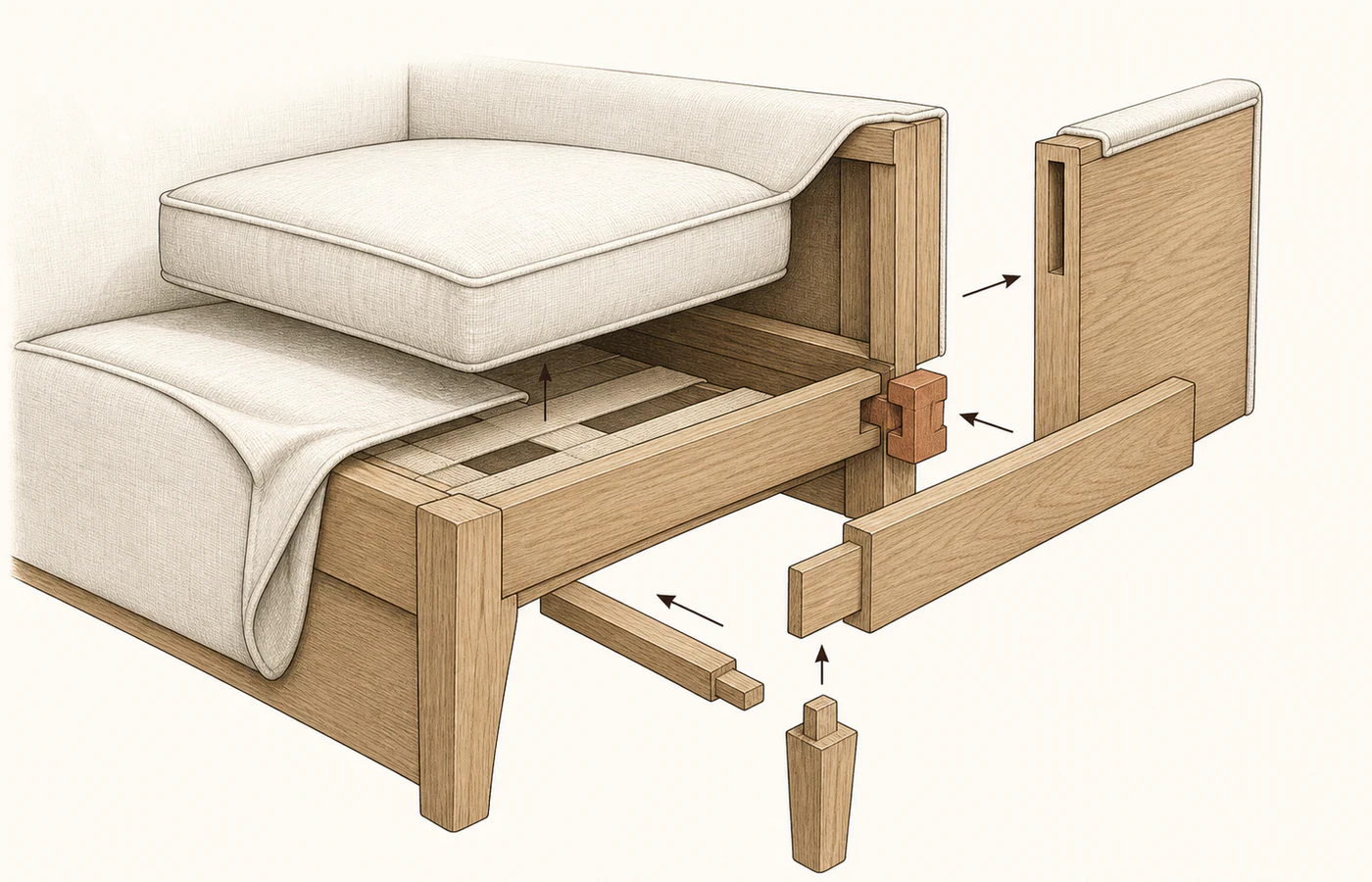
A durable exposed frame depends on load paths, reinforced joints and serviceable cushions—not the wood name alone.
Joinery and load paths: what to inspect
A sofa frame carries repeated dynamic loads. People do not lower themselves gently into the exact center every time; they drop onto edges, lean on arms and push off to stand. The most stressed areas are commonly:
- front rail to side rail;
- arm to frame;
- rear leg and back post;
- center span of long sofas;
- module connectors;
- points where suspension attaches.
Good joints spread load across wood surfaces rather than depending on one screw in end grain. Mechanical fasteners are not inherently bad; bolts can make a frame serviceable and modular. The concern is a joint that has no geometry, reinforcement or access for tightening.
Simple showroom frame test
With permission, lift one front corner slightly. A rigid frame should rise as a unit rather than twisting dramatically while the opposite front leg remains on the floor. Listen for creaks, but remember a floor model may have loose hardware rather than a failed frame. Ask whether bolts can be retightened.
Solid wood versus engineered wood
Engineered materials are not automatically inferior. Furniture-grade plywood can provide strong, dimensionally stable panels and curved components. Laminated veneer lumber and bent plywood can create shapes that would be inefficient or unstable in one solid piece.
Potential concerns include:
- thin particleboard at high-load connections;
- moisture-sensitive MDF near floor level;
- staples into low-density board;
- decorative veneer marketed as solid timber;
- lack of repair access.
The useful request is a component map: solid wood where, plywood where, board where, and why.
Finish ranking for exposed wooden arms
| Finish type | Best quality | Trade-off | What to ask |
|---|---|---|---|
| Hardwax oil | Natural feel and local repair | Needs periodic maintenance | Approved refresh product and stain response |
| Catalyzed lacquer | Strong everyday barrier | Harder to spot-repair invisibly | Heat, moisture and cleaner limits |
| Water-based clear coat | Lower odor and good color clarity | Quality varies by system | Number of coats and repair route |
| Traditional oil | Easy refresh and warm tone | Lower stain resistance | Drying time and maintenance interval |
| Paint / opaque finish | Uniform color | Chips expose substrate | Touch-up availability |
No finish is maintenance-free. Exposed sofa arms receive skin oils, cups, sunlight and impact, so request care instructions before purchase.
Cushion and suspension compatibility
Many exposed-frame sofas use loose cushions on webbing, slats or a platform. Inspect:
- whether seat cushions slide forward;
- whether anti-slip material is replaceable;
- spacing between slats or webbing;
- edge pressure from the front rail;
- cushion ties, Velcro or clips;
- replacement insert dimensions;
- whether back cushions can be reversed and rotated.
A beautiful frame becomes uncomfortable if the cushion bottoms out against a hard rail. Sit near the edge and center, not only in the display’s most comfortable spot.
Choose a wood-frame sofa by use
| Use case | Strong starting point | Watch for |
|---|---|---|
| Everyday family room | Oak, ash, beech, maple or documented rubberwood frame | Hard arms, loose cushions and sharp corners |
| Humid climate | Teak or well-finished kiln-dried hardwood | Mold in cushions and hidden unfinished surfaces |
| Frequent moves | Bolted modular wood frame | Excess weight and proprietary connectors |
| Formal room | Expressive oak, ash, sheesham or teak | Paying for species while ignoring comfort |
| Pet household | Durable clear coat and replaceable cushions | Claw marks on soft finish and exposed corners |
| Older users | Firm seat, supportive arms and moderate seat height | Very low platforms and deep loose cushions |
| Small apartment | Slim-arm exposed frame | Long one-piece rails that cannot turn through access routes |
Common wooden-sofa buying mistakes
Ranking species without ranking the frame
A prestigious species cannot compensate for weak rail dimensions or poor joints.
Assuming heavy means strong
Weight may come from dense wood, oversized upholstery or inexpensive board. It is not a direct quality measure.
Ignoring moisture movement
Solid timber expands and contracts. Panel orientation, joint allowance and indoor humidity matter.
Forgetting edge comfort
Exposed front rails and arms can be uncomfortable when cushions compress.
Buying fixed proprietary cushions
A long-lived frame needs a realistic cushion replacement route.
Treating finish damage as impossible
Ask how scratches, water rings and chips can be repaired before they occur.
Solid-wood sofa buying checklist
- Species and material map supplied
- Drying or moisture-control process documented
- Rail, leg and center support construction understood
- Joinery and reinforcement described
- Frame does not visibly rack or wobble
- Finish care and touch-up route confirmed
- Cushion attachment and replacement dimensions checked
- Suspension accessible and evenly supportive
- Exposed edges comfortable in real sitting positions
- Responsible sourcing claims documented
- Structural warranty read
- Delivery route, packaging and assembly plan measured
Frequently asked questions
Is solid wood always better than plywood?
No. High-quality plywood can be stronger and more dimensionally stable in panels or curved parts. The better frame uses each material appropriately and discloses the construction.
Which wood is strongest for a sofa?
Strength depends on species, grade, section size, grain direction and joint design. Oak, ash, beech and maple are strong common choices, but a well-built rubberwood frame can outperform a poorly built oak one.
Is rubberwood durable?
It can be a sound furniture hardwood when properly dried, treated and joined. The finished construction matters more than the name alone.
Does teak need oiling indoors?
Not always. Follow the maker’s finish-specific instructions. Unnecessary oil can change color or interfere with an existing coating.
Can an exposed wood sofa be reupholstered?
Often yes, especially when cushions are loose and dimensionally simple. Confirm whether covers, foam inserts and support components can be ordered separately.
How can I tell if a frame is kiln-dried?
You usually cannot verify it visually. Request written specification and warranty support rather than relying on a salesperson’s verbal claim.
Final verdict
The best solid-wood sofa is a transparent piece of construction: named materials, sensible joints, a stable load path, a repairable finish and cushions that can be renewed. Rank the complete frame first and the species second. For most buyers, documented kiln-dried hardwood construction in oak, ash, beech, maple or well-made rubberwood is a safer purchase than an exotic species presented without structural detail.
Sources and verification notes
- WoodenStreet Wooden Sofa Buying Guidewoodenstreet.comChecked August 6, 2026
- Living Shapes Sofa Buying Guidelivingshapes.inChecked August 6, 2026
- The Conran Shop Fabric and Sofa Buying Guidetheconranshop.comChecked August 6, 2026
- The Spruce Sofa Buying Guidethespruce.comChecked August 6, 2026
Policies, prices, product specifications and availability can change. Reopen official product and policy pages before publishing a time-sensitive update or making a purchase.