Category Buying Guide
Best Pet-Friendly Sofa Materials: Hair, Claws, Spills and Repairability Ranked
Compare eight pet-friendly sofa upholstery systems by snag resistance, hair removal, cleaning, scratch visibility, odor control and replacement options.

On this page
Quick answerKey takeawaysPet-friendly sofa rankings at a glanceHow we ranked pet-friendly sofa materialsStart with the animal’s actual behavior1. Tight-weave performance fabric — best overall2. Microfiber — best for hair removal and dense surface3. Protected top-grain leather — best wipe-clean dog option4. Washable removable slipcovers — best for accidents5. Indoor-outdoor or solution-dyed textile — best for heavy mess and sun6. Dense canvas or denim-style weave — best casual durability7. Synthetic velvet — best plush low-loop option8. Tight chenille — best conditional cozy choicePet behavior versus material matrixWeaves and surfaces that need extra cautionSofa design matters as much as fabricSwatch tests using real household conditionsCleaning and odor controlChemical and finish questionsPet-friendly sofa red flagsPet-friendly sofa buying checklistFrequently asked questionsFinal verdictNo sofa is pet-proof. A useful pet-friendly sofa reduces the damage caused by the specific animal in the home, makes ordinary soil easier to remove and allows worn parts to be replaced. A dog that sheds, a cat that scratches, a puppy with accidents and an older pet that drools create different material requirements.
Editorial status: This ranking compares common upholstery systems by typical behavior. It does not guarantee resistance to claws, urine, chewing or digging. Test swatches, follow manufacturer cleaning instructions and address pet behavior alongside material selection.
Quick answer
A tight, solution-dyed or otherwise well-documented performance weave is the best all-round pet sofa material. Microfiber ranks second for hair removal and snag resistance. Protected top-grain leather can be excellent for dogs and wipe-clean ownership but shows claw marks. A truly washable slipcover system is strongest for repeated accidents. Loose loops, open weaves and bonded surfaces generally create the most ownership risk.
Key takeaways
- Choose for the pet’s real behavior: shedding, scratching, digging, drool or accidents.
- Tight performance weaves and microfiber offer the broadest practical starting points.
- Protected leather is easy to wipe but should never be described as claw-proof.
- “Removable,” “washable” and “replaceable” covers are three separate claims.
- Recovery matters more than invulnerability: accessible cushions, cleanable gaps and spare covers extend useful life.
Pet-friendly sofa rankings at a glance
| Rank | Material or system | Best for | Main strength | Main compromise |
|---|---|---|---|---|
| 1 | Tight-weave performance fabric | Mixed pet households | Balanced snag, stain and color performance | Claims require verification |
| 2 | Microfiber / microsuede | Shedding pets and cats that do not aggressively scratch | Dense surface and easy hair removal | Shows pressure and oil marks |
| 3 | Protected top-grain leather | Dogs, drool and wipe-clean use | Hair does not embed and spills wipe quickly | Claws leave visible scratches |
| 4 | Washable removable slipcover | Puppies, older pets and accidents | Cover can be laundered or replaced | Refitting, shrinkage and inner-cushion contamination |
| 5 | Indoor-outdoor / solution-dyed textile | Heavy mess and sunrooms | Strong color and moisture performance | Hand feel may be firmer |
| 6 | Dense canvas or denim-style weave | Casual high-use rooms | Tough surface and repairable look | Can absorb spills and fade |
| 7 | Synthetic velvet | Low-snag plush option | Cut pile lacks large loops | Hair, shading and pressure marks show |
| 8 | Tight chenille | Calm dogs and soft family rooms | Comfortable and visually forgiving | Fuzzy yarn can catch and flatten |
How we ranked pet-friendly sofa materials
The ranking prioritizes:
- loop and snag structure;
- speed and clarity of cleaning;
- hair visibility and removal;
- liquid penetration into cushions;
- scratch and digging behavior;
- odor retention;
- ability to rotate, wash or replace covers;
- colorfastness and repeated cleaning tolerance;
- access under and between cushions.
Abrasion tests do not measure claw resistance, urine penetration or chewing. A “pet-friendly” badge without textile and care details is not enough.
Start with the animal’s actual behavior
Shedding
Choose a surface where hair remains visible enough to remove but does not embed deeply. Match the upholstery’s mid-tone color to the dominant pet hair if appearance between cleanings matters.
Scratching
Avoid large loops, open weaves and exposed piping. Dense, short surfaces provide fewer catching points, but no upholstery withstands repeated intentional scratching indefinitely.
Digging and nesting
Look for stable seat covers, strong seams and cushions that lock into position. Very loose cushions invite burrowing.
Accidents and drool
Prioritize fast liquid removal, waterproof or replaceable barriers beneath covers and cushion inserts that can be accessed. A washable outer cover is less useful if liquid immediately reaches non-washable foam.
Chewing
Material ranking becomes secondary. Avoid exposed zippers, loose decorative trim, wood corners and accessible mechanism cables; use behavior management and veterinary guidance where appropriate.
1. Tight-weave performance fabric — best overall
A dense flat weave with clear cleaning instructions offers the strongest broad solution for households with both hair and occasional spills. Solution-dyed fibers can provide strong color stability, while well-engineered finishes may slow liquid absorption.
Do not rely on the word performance. Ask for fiber content, weave, cleaning code, pilling data, stain-treatment details and whether the finish contains chemicals the household prefers to avoid. Test a swatch with real pet hair and the approved cleaner.
Why it ranks first: best balance across multiple pet risks.
Who should avoid it: buyers who cannot verify the treatment or need a fully machine-washable system.
2. Microfiber — best for hair removal and dense surface
Microfiber’s very fine, tightly packed fibers create a surface with few obvious loops. Hair can often be vacuumed, brushed or wiped away efficiently. It is generally less tempting to claws than a coarse woven texture.
Directional nap shows handprints and pressure. Body oil and saliva may darken frequently contacted areas. Use only approved cleaners and test color transfer.
Why it ranks second: practical density at accessible prices.
Who should avoid it: buyers who dislike shading or have pets that actively tear at all soft surfaces.
3. Protected top-grain leather — best wipe-clean dog option
Leather does not hold hair in a weave and can be wiped promptly after drool or muddy contact. A protected finish is more forgiving than natural aniline leather.
Claws leave marks. Large dogs launching onto the sofa can create scratches at the front rail and cushions. Choose a medium color and natural grain if minor marks should blend into patina. Avoid presenting leather as cat-proof.
Why it ranks third: excellent cleaning and low hair retention, offset by scratch visibility.
Who should avoid it: households with uncontrolled cat scratching or owners who require a pristine surface.
4. Washable removable slipcovers — best for accidents
A genuine washable-cover system allows contaminated upholstery to be removed rather than repeatedly spot-cleaned. Replacement covers can extend the sofa’s life and let owners keep a spare.
Verify every layer. Are seat, back, arm and frame covers removable? Is the fabric machine-washable or only removable for professional cleaning? Is the cushion insert protected? Can covers be purchased separately in the future?
Why it ranks fourth: strongest recovery route for repeated mess.
Who should avoid it: buyers who dislike a relaxed fit or cannot manage removal, washing and refitting.
5. Indoor-outdoor or solution-dyed textile — best for heavy mess and sun
Textiles designed for moisture, fading and repeated cleaning can be useful in sunrooms, porches and highly active pet homes. Modern versions can feel more residential than older stiff outdoor cloth.
The label still needs context. Confirm whether the complete sofa, not just the fabric, is suitable for damp environments. Indoor foam and timber can develop odor or damage even when the cover is robust.
Why it ranks fifth: strong surface performance with a potentially firmer hand and limited style range.
Who should avoid it: buyers prioritizing a soft natural texture above maintenance.
6. Dense canvas or denim-style weave — best casual durability
Substantial cotton or blended canvas can tolerate a lived-in appearance, and visible repairs may suit the style. It is useful for slipcovers and casual rooms.
Natural fibers can absorb liquid and fade. Choose a blend or washable system for pets with accidents. Inspect seams because thick fabric creates bulky stress points.
Why it ranks sixth: robust, honest appearance but not inherently stain resistant.
Who should avoid it: households needing rapid wipe-clean performance without laundering.
7. Synthetic velvet — best plush low-loop option
Velvet’s cut pile has fewer large snag loops than bouclé or open chenille. Some pet owners find hair can be removed with a rubber brush or vacuum head, and the plush surface may resist casual claw catching.
Hair, pressure marks and saliva can be visible. The nap changes direction and requires regular grooming. Cats can still puncture or scratch it.
Why it ranks seventh: a better pet option than many assume, but visually demanding.
Who should avoid it: heavy shedders without frequent cleaning or owners who want a uniform surface.
8. Tight chenille — best conditional cozy choice
Chenille can hide small marks and feel comfortable, but fuzzy yarns and raised texture can catch claws or hold hair. Only compact, well-backed versions belong on the shortlist.
Why it ranks eighth: acceptable for calm pets, less predictable for scratching and digging.
Who should avoid it: active cats, long-clawed dogs or buyers who dislike pile flattening.
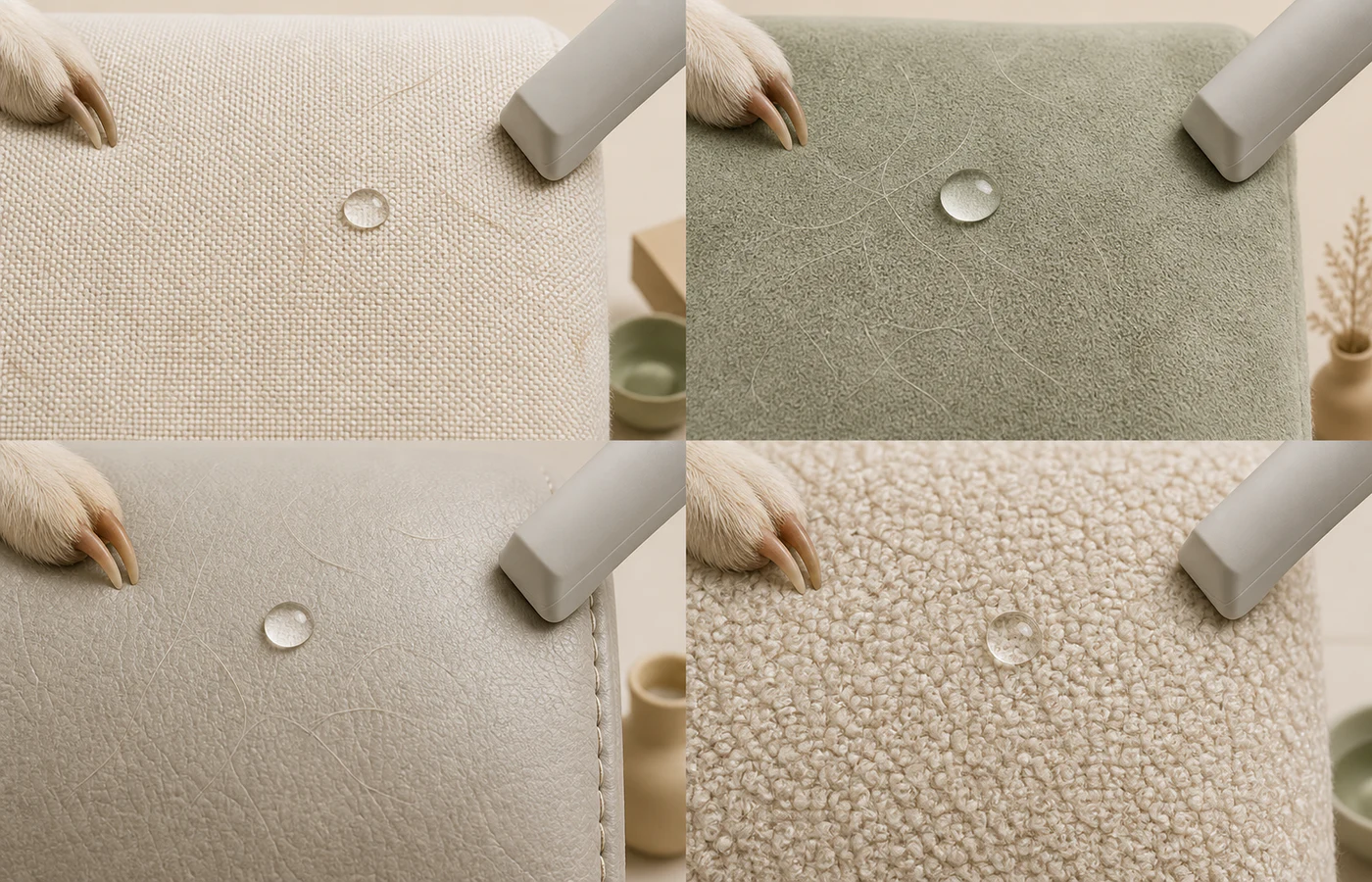
No upholstery is pet-proof; weave density, surface finish and cleanability change how each material handles hair, claws and spills.
Pet behavior versus material matrix
| Pet behavior | Best starting point | Conditional choice | Avoid first |
|---|---|---|---|
| Heavy shedding | Microfiber or medium-tone tight weave | Protected leather | Deep loose texture |
| Cat scratching | Dense flat weave plus scratching alternatives | Microfiber | Bouclé, open chenille, loose linen |
| Dog claws | Performance weave or protected grained leather | Canvas slipcover | Delicate aniline leather |
| Frequent accidents | Washable cover plus liquid barrier | Indoor-outdoor textile | Fixed absorbent upholstery |
| Drool | Protected leather or documented performance fabric | Washable slipcover | Untreated pale linen |
| Digging/nesting | Tight fixed upholstery and secured cushions | Dense canvas | Loose back cushions and looped fabric |
| Mud and outdoor use | Solution-dyed performance textile | Protected leather with prompt cleaning | Delicate velvet or natural linen |
Weaves and surfaces that need extra caution
Bouclé
Loops catch claws, tags and jewelry and can hold crumbs. A compact loop is better than a long irregular one, but this remains a high-risk choice for scratching pets.
Loose linen
Open weave and natural slubs can snag. Untreated linen absorbs liquid quickly and shows wrinkles and stains.
Bonded or low-quality faux leather
Claws can puncture the surface, while aging coatings may peel. Local repair can be difficult.
Silk and delicate decorative fabrics
These are poor everyday pet surfaces because staining, snagging and cleaning options are limited.
Very pale or very dark solid colors
Color does not change durability, but it changes visible maintenance. Select a tone that does not make every strand of hair a high-contrast line.
Sofa design matters as much as fabric
A pet-friendly sofa should also have:
- removable and reversible seat cushions;
- accessible gaps for vacuuming;
- minimal deep button tufting;
- replaceable covers or modules;
- protected zippers;
- legs high enough for cleaning or a sealed low base;
- no exposed recliner cables;
- robust seams and piping;
- cushions that do not slide during jumping;
- clear replacement-part policies.
A modular sofa can be valuable when one cover or module can be replaced. It can also create more crumb-catching gaps, so inspect the connection system.
Swatch tests using real household conditions
- Press actual pet hair into the sample and remove it using the intended tool.
- Drag a trimmed fingernail gently across the surface to look for catching.
- Bend the fabric to see whether the backing opens.
- Apply a small approved cleaning test to an edge.
- Rub with a damp white cloth to check color transfer.
- Place the sample where the sofa will sit to compare hair contrast and sunlight.
- Let the pet smell and lie near the sample, without encouraging chewing.
- Keep the exact swatch with the order record.
Do not perform destructive tests on a retailer’s sample without permission.
Cleaning and odor control
- Vacuum hair before applying moisture.
- Blot liquid promptly rather than rubbing it outward.
- Use enzyme products only when approved for the exact upholstery and backing.
- Test every product in a hidden area.
- Dry cushions thoroughly to prevent trapped odor.
- Do not saturate foam or use steam unless permitted.
- Rotate cushions to distribute oils and favorite sleeping spots.
- Launder removable covers according to temperature and drying instructions.
Persistent urine odor may require access to cushion inserts or professional treatment. Surface cleaning alone cannot remove contamination that has entered foam or frame materials.
Chemical and finish questions
Pet-friendly marketing sometimes relies on stain-repellent treatments. Buyers may wish to ask:
- Is the performance inherent to the fiber or topically applied?
- Does the manufacturer disclose the finish chemistry?
- Does repeated cleaning reduce performance?
- Are there restrictions for households with animals or children?
- Is an untreated alternative available?
The correct decision depends on household priorities; vague “non-toxic” claims should be supported by specific documentation.
Pet-friendly sofa red flags
- “Pet proof” or “scratch proof” guarantee without test scope.
- High abrasion result used as proof against claws.
- Removable covers that are not washable or replaceable.
- Fixed cushions with inaccessible inserts.
- Deep channels and tufting that cannot be vacuumed.
- White loose weave recommended universally for pets.
- Leather sold as cat-proof.
- No cleaning code or approved stain procedure.
- Warranty excludes all pet damage while marketing emphasizes pets.
- Replacement covers available only at time of purchase.
Pet-friendly sofa buying checklist
- Primary pet behavior identified
- Full-size swatch tested with actual hair
- Weave and snag structure inspected
- Cleaning code and approved products saved
- Liquid path into cushion assessed
- Removable, washable and replaceable confirmed separately
- Hair contrast checked in room lighting
- Seams, piping and zippers inspected
- Cushion rotation and replacement route confirmed
- Under-sofa and between-module cleaning access checked
- Warranty pet exclusions understood
- Scratching, chewing and accident management plan in place
Frequently asked questions
What is the best sofa fabric for cats?
A dense flat weave or microfiber offers fewer obvious loops than bouclé or loose chenille. No fabric survives determined scratching indefinitely, so provide appropriate scratching surfaces and behavioral management.
What is the best sofa material for dogs?
For shedding and muddy contact, tight performance fabric, microfiber or protected leather are strong starting points. The choice depends on claw behavior and whether visible scratches are acceptable.
Is leather or fabric better for pets?
Leather is easier for hair and many spills but shows claw marks. Fabric can hide scratches better and offer washable covers, but hair and odor may embed. Match the surface to the animal.
Are washable sofa covers enough for puppy accidents?
Only if liquid does not soak into non-washable cushion foam or the frame. Look for removable barriers, accessible inserts and replacement options.
Is velvet pet friendly?
Synthetic velvet can be more snag-resistant than looped fabrics because it has a cut pile, but it shows hair and pressure marks and is not scratch-proof.
Does a high rub count mean claw proof?
No. Abrasion tests do not reproduce a claw catching and pulling a yarn.
Final verdict
The best pet-friendly sofa is designed for recovery rather than invulnerability. A tightly woven performance textile ranks first because it handles the widest range of hair, dirt and ordinary spills. Microfiber is the strongest value option, protected leather is excellent for many dog homes and washable covers are the best accident-management system. Avoid vague pet-proof claims and buy the sofa whose covers, cushions and cleaning route can realistically be maintained or replaced.
Sources and verification notes
- Loft Home Pet-Proof Sofa Materials Guidelofthome.comChecked August 6, 2026
- Cellini Pet-Friendly Sofa Guidecellini.com.sgChecked August 6, 2026
- King Living Pets and Furniture Guidekingliving.comChecked August 6, 2026
- What A Room Pet-Friendly Sofa Guidewhataroom.comChecked August 6, 2026
- ACT Voluntary Performance Guidelinescontracttextiles.orgChecked August 6, 2026
Policies, prices, product specifications and availability can change. Reopen official product and policy pages before publishing a time-sensitive update or making a purchase.