Sofa comparison
Deep-Seat vs Standard-Depth Sofa: Which Seat Depth Fits Your Body and Lifestyle?
A body-aware deep-seat versus standard-depth sofa comparison covering posture, height, lounging, standing, room footprint, cushions and mixed-household comfort.

On this page
Quick verdictAt-a-glance comparisonWhy this question has a real search windowMeasure usable depth consistentlyUse the calf-gap testMatch depth to the main activityPlan for mixed heightsStanding, mobility and fatigueRoom footprint and circulationCushions change depth over timeBest choice by household and use caseA five-minute body-fit testA repeatable showroom and swatch testCommon buying mistakesPre-purchase checklistFrequently asked questionsFinal decision rule“Deep” and “standard” are retail descriptions rather than universal measurement bands. The usable distance from the compressed front edge to the back support is what the body experiences. Loose cushions, reclined backs and soft seats can make effective depth much greater than the catalog number.
How to use this guide: Retail labels are inconsistent. Compare the exact dimensions, materials, mechanism, care instructions and current policies of the product you are considering. The recommendations below are decision rules rather than universal promises.
Quick verdict
Choose a deep seat when curling up, cross-legged lounging, movie nights and naps dominate and shorter sitters accept movable back pillows. Choose a moderate depth when conversation, upright work, easy standing and mixed body sizes matter more. Measure the person and posture, not only the room.
At-a-glance comparison
| Decision factor | Deep-seat sofa | Moderate-depth sofa |
|---|---|---|
| Default posture | Reclined, curled or cross-legged | Upright with feet more likely to reach floor |
| Shorter users | Often need a back or lumbar pillow | More likely to reach support naturally |
| Tall users | More thigh support and lounge room | Can feel cramped if too shallow |
| Standing | Harder when also low and soft | Usually easier with moderate height and firmness |
| Room footprint | Often deeper overall | Usually smaller, not guaranteed |
| Napping | More surface for turning | Width and arms matter more |
| Coffee-table use | Longer reach from back support | Easier upright reach |
Why this question has a real search window
Current 2026 explainers and ergonomics pages show a strong buyer-pain window around sofa depth. The intent is practical and high-value: people are trying to avoid dangling feet, unsupported backs, difficult standing and a sofa that consumes more room than expected.
Measure usable depth consistently
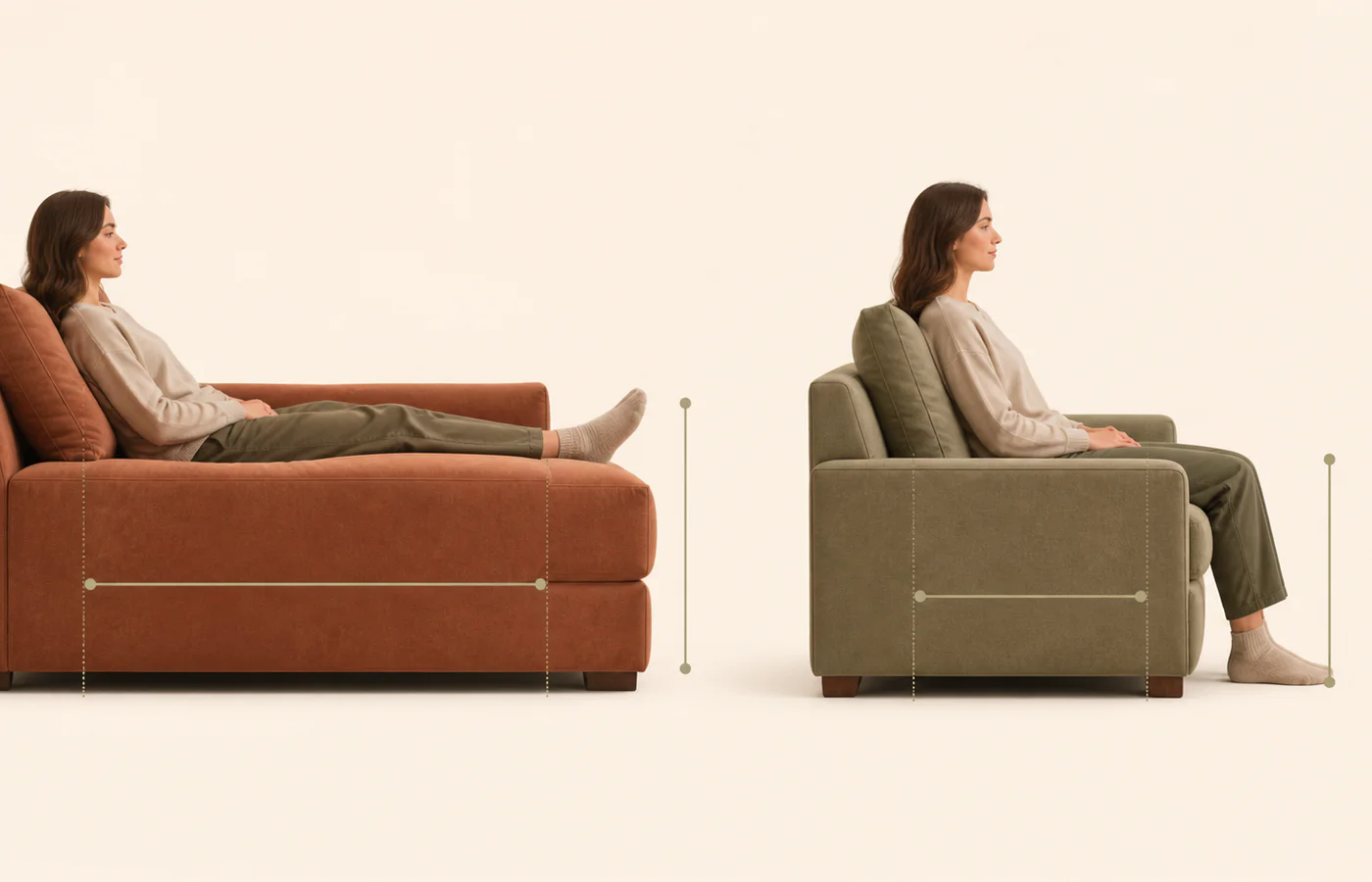
Measure horizontally from the front edge to the point where the loaded back cushion supports the body. Record whether the seat and back are compressed. Retailers may measure to the frame, loose cushion or along a slope, so numbers from different brands are not automatically comparable. Record seat height, angle and softness. A low soft 23-inch seat can feel deeper than a firm 25-inch seat because the hips sink and the torso reclines.
Use the calf-gap test
Sit with the pelvis against the back and shoulders relaxed. The front edge should not press behind the knees. If the feet dangle or the sitter slides forward, the seat is too deep for that upright posture. A full back pillow can convert a deep seat into a shallower one, but it consumes usable space and must stay stable. Test with the exact pillows that will be used.
Match depth to the main activity
Deep seating excels for movies, gaming, naps, cross-legged reading and casual gatherings. Moderate depth supports conversation, coffee-table use, brief laptop work and frequent standing. If the room serves both, use a chaise, ottoman or mixed-depth sectional rather than making every seat equally deep.
Plan for mixed heights
A sofa chosen for the tallest lounger can frustrate shorter household members. Test the shortest frequent sitter first, then give taller users an ottoman or chaise. Alternatively, use substantial movable back cushions. Seat width and arm shape also matter. A tall user may enjoy a moderate seat when able to turn sideways; a shorter user may love a deep seat when curling up.
Standing, mobility and fatigue
Deep seats are hardest to leave when paired with low height, soft foam and no stable arm. The body travels farther forward before the feet come under the knees. Repeat the stand-up motion, not just the first comfortable sit. A firmer front edge and stable arms can make a moderately deep seat manageable.
Room footprint and circulation
Tape overall depth, not only seat depth. Thick backs and broad arms add inches that do not create useful sitting space. Leave walking clearance and check TV and coffee-table distances. A deep armless module can use space more efficiently than a shallow sofa with oversized rolled arms. Compare usable seat area with total footprint.
Cushions change depth over time
Feather-rich seats can increase effective depth as they compress. Dense foam may remain supportive but feel firm initially. Loose backs allow adjustment; fixed backs lock the geometry. Ask whether cushions are reversible and replaceable and how much fluffing is expected. The showroom depth can change after break-in.
Best choice by household and use case
| Situation | Better starting point | Why |
|---|---|---|
| Movie and gaming room | Deep seat | Supports reclined and cross-legged positions |
| Formal conversation room | Moderate depth | Keeps users upright |
| Tall household | Moderate-deep with suitable height | Adds thigh support |
| Short household | Moderate or deep with substantial pillows | Feet and back should work together |
| Frequent laptop use | Moderate depth | Reduces forward reach |
| Mobility concerns | Moderate, firm, with stable arms | Easier standing |
| Small apartment | Compare total footprint | A compact deep module can beat bulky shallow arms |
A five-minute body-fit test
Use the same sequence for every sofa you shortlist. First, sit fully back without adding a pillow and keep both feet flat. Note whether the front edge presses into the calf or stops several inches behind the knee. Second, remain upright for five minutes rather than judging the first soft impression. Third, cross one leg, curl up and lie sideways to test the lounge positions that make deeper seating attractive. Finally, stand without pushing hard on the arms.
Record the result for the shortest regular user, the tallest regular user and anyone with knee, hip or back limitations. A household compromise may be a moderately deep seat with movable lumbar cushions rather than the deepest available frame.
| Test result | Likely implication |
|---|---|
| Feet dangle when the back is supported | Seat is too deep, too high or both for upright use |
| Lower back loses contact after several minutes | Add lumbar support or choose less usable depth |
| Knees sit well above hips in a soft seat | Standing may become harder as cushions soften |
| Tall user cannot relax thighs on the seat | More usable depth may improve lounging |
| Everyone needs multiple corrective pillows | The base geometry is probably the wrong compromise |
Do not treat decorative pillows as proof that a poor fit has been solved. Include the cost, storage and daily rearrangement of support pillows in the ownership decision.
A repeatable showroom and swatch test
Use the same sequence for every shortlisted model so a persuasive salesperson or attractive room photograph does not reset the criteria:
- Photograph the full specification and price, including the exact upholstery, fill and configuration.
- Measure the loaded seat depth, seat height, back contact point and usable width.
- Sit upright for at least ten minutes, lounge in the household’s normal posture and repeat the stand-up motion.
- Test the least comfortable-looking position: a connector seam, center seat, corner, front edge or mechanism transition.
- Recreate the full footprint at home with tape, including open or converted dimensions where relevant.
- Price delivery, assembly, returns, replacement covers or cushions and the likely repair route.
- Save screenshots or PDFs of date-sensitive policies before placing the order.
Common buying mistakes
- Using a brand’s “deep” label without measurement.
- Ignoring height, angle and softness.
- Testing without sitting fully back.
- Choosing for the tallest person only.
- Assuming every deep sofa is good for naps.
- Forgetting the table and walking route.
Pre-purchase checklist
- Loaded usable depth measured.
- Shortest and tallest users tested.
- Calf gap and foot support checked.
- Standing repeated.
- Dominant activities listed.
- Overall footprint taped.
- Back pillows included.
- Cushion softening and replacement reviewed.
Frequently asked questions
What depth counts as deep?
There is no universal cutoff. Many buyers experience roughly 23–25 inches as lounge-oriented, but angle, cushion and body size shift the threshold.
Is deep better for tall people?
Often, but not automatically. Height, angle and thigh length still matter.
Can a short person enjoy a deep sofa?
Yes for curling up, or with a stable full back pillow that reduces effective depth.
Does deeper always require a bigger room?
Usually, but slim arms and backs can offset part of the difference.
Why does delivered depth feel different from showroom depth?
Break-in, fill, missing pillows and inconsistent measurement can all change the feel.
Final decision rule
Choose a deep seat when curling up, cross-legged lounging, movie nights and naps dominate and shorter sitters accept movable back pillows. Choose a moderate depth when conversation, upright work, easy standing and mixed body sizes matter more. Measure the person and posture, not only the room.
Sources and verification notes
- Magic Home — Standard vs Deep Seat Sofasmagichome.comChecked August 6, 2026
- Delo Furniture — Deep Seat vs Standard Seat Depthdelofurniture.comChecked August 6, 2026
- Maxi Home — Sofa Ergonomicsmaxihome.com.sgChecked August 6, 2026
- Article Sven 88-Inch Sofaarticle.comChecked August 6, 2026
- IKEA UPPLAND Sofaikea.comChecked August 6, 2026
- IKEA SÖDERHAMN Sofa Sectionikea.comChecked August 6, 2026
- Crate & Barrel — Types of Sofascrateandbarrel.comChecked August 6, 2026
- Good Housekeeping — Perfect Sofa Heightgoodhousekeeping.comChecked August 6, 2026
Policies, prices, product specifications and availability can change. Reopen official product and policy pages before publishing a time-sensitive update or making a purchase.